Shop Amazon

Showing posts with label Hell in a Handbasket. Show all posts

Sunday, April 1, 2012

The Illegitimacy of Violence, the Violence of Legitimacy


What is violence? Who gets to define it? Does it have a place in the pursuit of liberation? These age-old questions have returned to the fore during the Occupy movement. But this discussion never takes place on a level playing field; while some delegitimize violence, the language of legitimacy itself paves the way for the authorities to employ it.

“Though lines of police on horses, and with dogs, charged the main street outside the police station to push rioters back, there were significant pockets of violence which they could not reach.”
The New York Times, on the UK riots of August 2011

During the 2001 FTAA summit in Quebec City, one newspaper famously reported thatviolence erupted when protesters began throwing tear gas canisters back at the lines of riot police. When the authorities are perceived to have a monopoly on the legitimate use of force, “violence” is often used to denote illegitimate use of force—anything that interrupts or escapes their control. This makes the term something of afloating signifier, since it is also understood to mean “harm or threat that violates consent.”
This is further complicated by the ways our society is based on and permeated byharm or threat that violates consent. In this sense, isn’t it violent to live on colonized territory, destroying ecosystems through our daily consumption and benefitting from economic relations that are forced on others at gunpoint? Isn’t it violent for armed guards to keep food and land, once a commons shared by all, from those who need them? Is it more violent to resist the police who evict people from their homes, or to stand aside while people are made homeless? Is it more violent to throw tear gas canisters back at police, or to denounce those who throw them back as “violent,” giving police a free hand to do worse?
In this state of affairs, there is no such thing as nonviolence—the closest we can hope to come is to negate the harm or threat posed by the proponents of top-down violence. And when so many people are invested in the privileges this violence affords them, it’s naïve to think that we could defend ourselves and others among the dispossessed without violating the wishes of at least a few bankers and landlords. So instead of asking whether an action is violent, we might do better to ask simply: does it counteract power disparities, or reinforce them?
This is the fundamental anarchist question. We can ask it in every situation; every further question about values, tactics, and strategy proceeds from it. When the question can be framed thus, why would anyone want to drag the debate back to the dichotomy of violence and nonviolence?
The discourse of violence and nonviolence is attractive above all because it offers an easy way to claim the higher moral ground. This makes it seductive both for criticizing the state and for competing against other activists for influence. But in a hierarchical society, gaining the higher ground often reinforces hierarchy itself.
Legitimacy is one of the currencies that are unequally distributed in our society, through which its disparities are maintained. Defining people or actions as violent is a way of excluding them from legitimate discourse, of silencing and shutting out. This parallels and reinforces other forms of marginalization: a wealthy white person can act “nonviolently” in ways that would be seen as violent were a poor person of color to do the same thing. In an unequal society, the defining of “violence” is no more neutral than any other tool.
Defining people or actions as violent also has immediate consequences: it justifies the use of force against them. This has been an essential step in practically every campaign targeting communities of color, protest movements, and others on the wrong side of capitalism. If you’ve attended enough mobilizations, you know that it’s often possible to anticipate exactly how much violence the police will use against a demonstration by the way the story is presented on the news the night before. In this regard, pundits and even rival organizers can participate in policing alongside the police, determining who is a legitimate target by the way they frame the narrative.
On the one-year anniversary of the Egyptian uprising, the military lifted the Emergency Laws—“except in thug-related cases.” The popular upheaval of 2011 had forced the authorities to legitimize previously unacceptable forms of resistance, with Obama characterizing as “nonviolent” an uprising in which thousands had fought police and burned down police stations. In order to re-legitimize the legal apparatus of the dictatorship, it was necessary to create a new distinction between violent “thugs” and the rest of the population. Yet the substance of this distinction was never spelled out; in practice, “thug” is simply the word for a person targeted by the Emergency Laws. From the perspective of the authorities, ideally the infliction of violence itselfwould suffice to brand its victims as violent—i.e., as legitimate targets.[1]
So when a broad enough part of the population engages in resistance, the authorities have to redefine it as nonviolent, even if it would previously have been considered violent. Otherwise, the dichotomy between violence and legitimacy might erode—and without that dichotomy, it would be much harder to justify the use of force against those who threaten the status quo. By the same token, the more ground we cede in what we permit the authorities to define as violent, the more they will sweep into that category, and the greater risk all of us will face. One consequence of the past several decades of self-described nonviolent civil disobedience is that some people regard merely raising one’s voice as violent; this makes it possible to portray those who take even the most tentative steps to protect themselves against police violence as violent thugs.

“The individuals who linked arms and actively resisted, that in itself is an act of violence… linking arms in a human chain when ordered to step aside is not a nonviolent protest.”
-UC police captain Margo Bennett,
quoted in The San Francisco Chronicle,
justifying the use of force against students
at the University of California at Berkeley

The Master’s Tools: Delegitimization, Misrepresentation, and Division
Violent repression is only one side of the two-pronged strategy by which social movements are suppressed. For this repression to succeed, movements must be divided into legitimate and illegitimate, and the former convinced to disown the latter—usually in return for privileges or concessions. We can see this process up close in the efforts of professional journalists like Chris Hedges and Rebecca Solnit to demonize rivals in the Occupy movement.
In last year’s Throwing Out the Master’s Tools and Building a Better House: Thoughts on the Importance of Nonviolence in the Occupy Revolution,” Rebecca Solnit mixed together moral and strategic arguments against “violence,” hedging her bets with a sort of US exceptionalism: Zapatistas can carry guns and Egyptian rebels set buildings on fire, but let no one so much as burn a trash can in the US. At base, her argument was that only “people power” can achieve revolutionary social change—and that “people power” is necessarily nonviolent.
Solnit should know that the defining of violence isn’t neutral: in her article “The Myth of Seattle Violence,” she recounted her unsuccessful struggle to get the New York Times to stop representing the demonstrations against the 1999 WTO summit in Seattle as “violent.” In consistently emphasizing violence as her central category, Solnit is reinforcing the effectiveness of one of the tools that will inevitably be used against protesters—including her—whenever it serves the interests of the powerful.
Solnit reserves particular ire for those who endorse diversity of tactics as a way to preclude the aforementioned dividing of movements. Several paragraphs of “Throwing Out the Master’s Tools” were devoted to denouncing the CrimethInc. “Dear Occupiers” pamphlet: Solnit proclaimed it “a screed in justification of violence,” “empty machismo peppered with insults,” and stooped to ad hominem attacks on authors about whom she admittedly knew nothing.[2]
As anyone can readily ascertain, the majority of “Dear Occupiers” simply reviews the systemic problems with capitalism; the advocacy of diversity of tactics is limited to a couple subdued paragraphs. Why would an award-winning author represent this as a pro-violence screed?
Perhaps for the same reason that she joins the authorities in delegitimizing violence even when this equips them to delegitimize her own efforts: Solnit’s leverage in social movements and her privileges in capitalist society are both staked on the distinction between legitimate and illegitimate. If social movements ever cease to be managed from the top down—if they stop policing themselves—the Hedges and Solnits of the world will be out of a job literally as well as figuratively. That would explain why they perceive their worst enemies to be those who soberly advise against dividing movements into legitimate and illegitimate factions.
It’s hard to imagine Solnit would have represented “Dear Occupiers” the way she did if she expected her audience to read it. Given her readership, this is a fairly safe bet—Solnit is often published in the corporate media, while CrimethInc. literature is distributed only through grass-roots networks; in any case, she didn’t include a link. Chris Hedges took similar liberties in his notorious “The Cancer in Occupy,” a litany of outrageous generalizations about “black bloc anarchists.” It seems that both authors’ ultimate goal is silencing: Why would you want to hear what those people have to say? They’re violent thugs.
The title of Solnit’s article is a reference to Audre Lorde’s influential text, “The Master’s Tools Will Never Dismantle the Master’s House.” Lorde’s text was not an endorsement of nonviolence; even Derrick Jensen, whom Hedges quotes approvingly, has debunked such misuse of this quotation. Here, let it suffice to repeat that the most powerful of the master’s tools is not violence, but delegitimization and division—as Lorde emphasized in her text. To defend our movements against these, Lorde exhorted us:
“Difference must be not merely tolerated, but seen as a fund of necessary polarities between which our creativity can spark… Only within that interdependency of different strengths, acknowledged and equal, can the power to seek new ways of being in the world generate, as well as the courage and sustenance to act where there are no charters.”
If we are to survive, that means:
“…learning how to stand alone, unpopular and sometimes reviled, and how to make common cause with those others identified as outside the structures in order to define and seek a world in which we can all flourish… learning how to take our differences and make them strengths. For the master’s tools will never dismantle the master’s house.”
It is particularly shameless that Solnit would quote Lorde’s argument against silencing out of context in order to delegitimize and divide. But perhaps we should not be surprised when successful professionals sell out anonymous poor people: they have to defend their class interests, or else risk joining us. For the mechanisms that raise people to positions of influence within activist hierarchies and liberal media are not neutral, either; they reward docility, often coded as “nonviolence,” rendering invisible those whose efforts actually threaten capitalism and hierarchy.
The Lure of Legitimacy
When we want to be taken seriously, it’s tempting to claim legitimacy any way we can. But if we don’t want to reinforce the hierarchies of our society, we should be careful not to validate forms of legitimacy that perpetuate them.
It is easy to recognize how this works in some situations: when we evaluate people on the basis of their academic credentials, for example, this prioritizes abstract knowledge over lived experience, centralizing those who can get a fair shot in academia and marginalizing everyone else. In other cases, this occurs more subtly. We emphasize our status as community organizers, implying that those who lack the time or resources for such pursuits are less entitled to speak. We claim credibility as longtime locals, implicitly delegitimizing all who are not—including immigrants who have been forced to move to our neighborhoods because their communities have been wrecked by processes originating in ours. We justify our struggles on the basis of our roles within capitalist society—as students, workers, taxpayers, citizens—not realizing how much harder this can make it for the unemployed, homeless, and excluded to justify theirs.
We’re often surprised by the resulting blowback. Politicians discredit our comrades with the very vocabulary we popularized: “Those aren’t activists, they’re homeless people pretending to be activists.” “We’re not targeting communities of color, we’re protecting them from criminal activity.” Yet we prepared the way for this ourselves by affirming language that makes legitimacy conditional.
When we emphasize that our movements are and must be nonviolent, we’re doing the same thing. This creates an Other that is outside the protection of whatever legitimacy we win for ourselves—that is, in short, a legitimate target for violence. Anyone who pulls their comrades free from the police rather than waiting passively to be arrested—anyone who makes shields to protect themselves from rubber bullets rather than abandoning the streets to the police—anyone who is charged with assault on an officer for being assaulted by one: all these unfortunates are thrown to the wolves as the violent ones, the bad apples. Those who must wear masks even in legal actions because of their precarious employment or immigration status are denounced as cancer, betrayed in return for a few crumbs of legitimacy from the powers that be. We Good Citizens can afford to be perfectly transparent; we would never commit a crime or harbor a potential criminal in our midst.
And the Othering of violence smooths the way for the violence of Othering. The ones who bear the worst consequences of this are not the middle class brats pilloried in internet flame wars, but the same people on the wrong side of every other dividing line in capitalism: the poor, the marginalized, those who have no credentials, no institutions to stand up for them, no incentive to play the political games that are slanted in favor of the authorities and perhaps also a few jet-setting activists.
Simply delegitimizing violence can’t put an end to it. The disparities of this society couldn’t be maintained without it, and the desperate will always respond by acting out, especially when they sense that they’ve been abandoned to their fate. But this kind of delegitimization can create a gulf between the angry and the morally upright, the “irrational” and the rational, the violent and the social. We saw the consequences of this in the UK riots of August 2011, when many of the disenfranchised, despairing of bettering themselves through any legitimate means, hazarded a private war against property, the police, and the rest of society. Some of them had attempted to participate in previous popular movements, only to be stigmatized as hooligans; not surprisingly, their rebellion took an antisocial turn, resulting in five deaths and further alienating them from other sectors of the population.
The responsibility for this tragedy rests not only on the rebels themselves, nor on those who imposed the injustices from which they suffered, but also upon the activists who stigmatized them rather than joining in creating a movement that could channel their anger. If there is no connection between those who intend to transform society and those who suffer most within it, no common cause between the hopeful and the enraged, then when the latter rebel, the former will disown them, and the latter will be crushed along with all hope of real change. No effort to do away with hierarchy can succeed while excluding the disenfranchised, the Others.
What should be our basis for legitimacy, then, if not our commitment to legality, nonviolence, or any other standard that hangs our potential comrades out to dry? How do we explain what we’re doing and why we’re entitled to do it? We have to mint and circulate a currency of legitimacy that is not controlled by our rulers, that doesn’t create Others.
As anarchists, we hold that our desires and well-being and those of our fellow creatures are the only meaningful basis for action. Rather than classifying actions as violent or nonviolent, we focus on whether they extend or curtail freedom. Rather than insisting that we are nonviolent, we emphasize the necessity of interrupting the violence inherent in top-down rule. This might be inconvenient for those accustomed to seeking dialogue with the powerful, but it is unavoidable for everyone who truly wishes to abolish their power.
Conclusion: Back to Strategy
But how do we interrupt the violence of top-down rule? The partisans of nonviolence frame their argument in strategic as well as moral terms: violence alienates the masses, preventing us from building the “people power” we need to triumph.
There is a kernel of truth at the heart of this. If violence is understood as illegitimate use of force, their argument can be summarized as a tautology: delegitimized action is unpopular.
Indeed, those who take the legitimacy of capitalist society for granted are liable to see anyone who takes material steps to counteract its disparities as violent. The challenge facing us, then, is to legitimize concrete forms of resistance: not on the grounds that they are nonviolent, but on the grounds that they are liberating, that they fulfill real needs and desires.
This is not an easy matter. Even when we passionately believe in what we are doing, if it is not widely recognized as legitimate we tend to sputter when asked to explain ourselves. If only we could stay within the bounds prescribed for us within this system while we go about overthrowing it! The Occupy movement was characterized by attempts to do just that—citizens insisting on their right to occupy public parks on the basis of obscure legal loopholes, making tortuous justifications no more convincing to onlookers than to the authorities. People want to redress the injustices around them, but in a highly regulated and controlled society, there’s so little they feel entitled to do.
Solnit may be right that the emphasis on nonviolence was essential to the initial success of Occupy Wall Street: people want some assurance that they’re not going to have to leave their comfort zones, and that what they’re doing will make sense to everyone else. But it often happens that the preconditions for a movement become limitations that it must transcend: Occupy Oakland remained vibrant after other occupations died down because it embraced a diversity of tactics, not despite this. Likewise, if we really want to transform our society, we can’t remain forever within the narrow boundaries of what the authorities deem legitimate: we have to extend the range of what people feel entitled to do.

All the media coverage in the world won’t help us if we fail to create a situation in which people feel entitled to defend themselves and each other.
Legitimizing resistance, expanding what is acceptable, is not going to be popular at first—it never is, precisely because of the tautology set forth above. It takes consistent effort to shift the discourse: calmly facing outrage and recriminations, humbly emphasizing our own criteria for what is legitimate.
Whether we think this challenge is worthwhile depends on our long-term goals. As David Graeber has pointed out, conflicts over goals often masquerade as moral and strategic differences. Making nonviolence the central tenet of our movement makes good sense if our long-term goal is not to challenge the fundamental structure of our society, but to build a mass movement that can wield legitimacy as defined by the powerful—and that is prepared to police itself accordingly. But if we really want to transform our society, we have to transform the discourse of legitimacy, not just position ourselves well within it as it currently exists. If we focus only on the latter, we will find that terrain slipping constantly from beneath our feet, and that many of those with whom we need to find common cause can never share it with us.
It’s important to have strategic debates: shifting away from the discourse of nonviolence doesn’t mean we have to endorse every single broken window as a good idea.. But it only obstructs these debates when dogmatists insist that all who do not share their goals and assumptions—not to say their class interests!—have no strategic sense. It’s also not strategic to focus on delegitimizing each other’s efforts rather than coordinating to act together where we overlap. That’s the point of affirming a diversity of tactics: to build a movement that has space for all of us, yet leaves no space for domination and silencing—a “people power” that can both expand and intensify.
Further Reading
Debating Tactics: Remember to Ask, “What Works?”
Historicizing “Violence”: Thoughts on the Hedges/Graeber Debate

“Those who said that the Egyptian revolution was peaceful did not see the horrors that police visited upon us, nor did they see the resistance and even force that revolutionaries used against the police to defend their tentative occupations and spaces: by the government’s own admission, 99 police stations were put to the torch, thousands of police cars were destroyed, and all of the ruling party’s offices around Egypt were burned down. Barricades were erected, officers were beaten back and pelted with rocks even as they fired tear gas and live ammunition on us . . . if the state had given up immediately we would have been overjoyed, but as they sought to abuse us, beat us, kill us, we knew that there was no other option than to fight back.”
Solidarity statement from Cairo to Occupy Wall Street, October 24, 2011
via projectcensored.org

Tuesday, November 22, 2011

Woman ticketed in late-night vacuuming | NewsOK.com

Woman ticketed in late-night vacuuming

An Oklahoma City woman was cited on an excessive noise complaint after a neighbor called police and said she had been running her vacuum after midnight for more than an hour.

FROM STAFF REPORTS    Comment on this article Leave a comment
Published: November 22, 2011

A late-night vacuuming session ended with a northwest Oklahoma City woman being cited for excessive noise, according to a police report.

Shelly Lea Armstrong, 42, was cited after her neighbor, Joe Wayne Green, 74, called police on Nov. 15 to report Armstrong had been running a vacuum cleaner in the apartment next door for about an hour after midnight.

According to the report, Armstrong was not using a vacuum when police arrived. Green signed a complaint against his neighbor and police presented Armstrong with a ticket. She was not arrested.

Neither Armstrong nor Green could be reached for comment on Tuesday.

Police said the fine for excessive noise typically is $167.

Massive Hydrovolcanic Explosion Inevitable at Fukushima - Infowars

Kurt Nimmo
Infowars.com
November 22, 2011

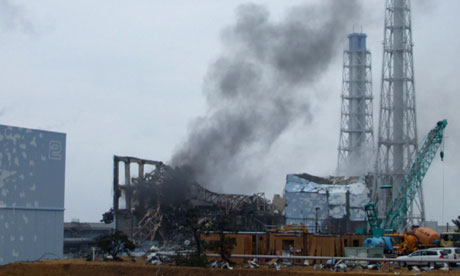
On November 17, the architect of Fukushima Daiichi Reactor 3, Uehara Haruo, was interviewed in Japan. He warned that a “China Syndrome” situation is inevitable at the plant.

Haruo said that considering eight months have passed since the tsunami and the crippling of the nuclear plant without any improvement in the condition of the reactors, it is likely melted fuel has escaped the container vessel and is now burning through the earth.

On September 20, 2011, Hiroaki Koide, assistant professor at Kyoto University’s Research Reactor Institute, estimated that material from the nuclear fuel rods may be twelve meters deep underground at reactors one and three.

Haruo said debris is spreading in Pacific Ocean. On November 15, tons of radioactive debris reached the Marshall Islands.

If the fuel reaches an underground water source, Haruo explained, it will result in the contamination of water, soil and the sea. More catastrophic, underground super-heated water will ultimately create a massive hydrovolcanic explosion.

Although media in Japan and the alternative media have covered this story over the last few days, it has been uniformly ignored by the corporate media.

Fukushima is no longer news worthy. Instead, the corporate media has turned its attention to Rob Kardashian and Dancing with the Stars and the other major distraction that is likely to persist through the holidays, the re-opened 30 year old murder investigation of actress Natalie Wood.

Thursday, November 10, 2011

'Fracking' chemical found in town's aquifer - US news

By
updated 11/10/2011 4:34:55 PM ET2011-11-10T21:34:55

As the country awaits results from a nationwide safety study on the natural gas drilling process of fracking, a separate government investigation into contamination in a place where residents have long complained that drilling fouled their water has turned up alarming levels of underground pollution.

A pair of environmental monitoring wells drilled deep into an aquifer in Pavillion, Wyo., contain high levels of cancer-causing compounds and at least one chemical commonly used in hydraulic fracturing, according to new water test results released yesterday by the Environmental Protection Agency.

The findings are consistent with water samples the EPA has collected from at least 42 homes in the area since 2008, when ProPublica began reporting on foul water and health concerns in Pavillion and the agency started investigating reports of contamination there.

Last year -- after warning residents not to drink or cook with the water and to ventilate their homes when they showered -- the EPA drilled the monitoring wells to get a more precise picture of the extent of the contamination.

The Pavillion area has been drilled extensively for natural gas over the last two decades and is home to hundreds of gas wells. Residents have alleged for nearly a decadethat the drilling -- and hydraulic fracturing in particular -- has caused their water to turn black and smell like gasoline. Some residents say they suffer neurological impairment, loss of smell, and nerve pain they associate with exposure to pollutants.

The gas industry -- led by the Canadian company EnCana, which owns the wells in Pavillion -- has denied that its activities are responsible for the contamination. EnCana has, however, supplied drinking water to residents.

The information released yesterday by the EPA was limited to raw sampling data: The agency did not interpret the findings or make any attempt to identify the source of the pollution. From the start of its investigation, the EPA has been careful to consider all possible causes of the contamination and to distance its inquiry from the controversy around hydraulic fracturing.

Still, the chemical compounds the EPA detected are consistent with those produced from drilling processes, including one -- a solvent called 2-Butoxyethanol (2-BE) -- widely used in the process of hydraulic fracturing. The agency said it had not found contaminants such as nitrates and fertilizers that would have signaled that agricultural activities were to blame.

The wells also contained benzene at 50 times the level that is considered safe for people, as well as phenols -- another dangerous human carcinogen -- acetone, toluene, naphthalene and traces of diesel fuel.

The EPA said the water samples were saturated with methane gas that matched the deep layers of natural gas being drilled for energy. The gas did not match the shallower methane that the gas industry says is naturally occurring in water, a signal that the contamination was related to drilling and was less likely to have come from drilling waste spilled above ground.

EnCana has recently agreed to sell its wells in the Pavillion area to Texas-based oil and gas company Legacy Reserves for a reported $45 million, but has pledged to continue to cooperate with the EPA's investigation. EnCana bought many of the wells in 2004, after the first problems with groundwater contamination had been reported.

The EPA's research in Wyoming is separate from the agency's ongoing national study of hydraulic fracturing's effect on water supplies, and is being funded through the Superfund cleanup program.

The EPA says it will release a lengthy draft of the Pavillion findings, including a detailed interpretation of them, later this month.

Sunday, November 6, 2011

Curious Message from the AMA | Armageddon Medicine

At least for now, things are looking bad for doctors treating Medicare patients, with a nearly 30% pay cut coming January 2012, unless Congress intervenes. So the AMA has been...

At least for now, things are looking bad for doctors treating Medicare patients, with a nearly 30% pay cut coming January 2012, unless Congress intervenes.

So the AMA has been sending messages to doctors about our options for 2012, including opting out of Medicare.

Now the curious part is this: along with the opting out information came a solicitation to order a new book:

Death in Large Numbers: the Science, Policy, and Management of Mass Fatality Events

(Along with this they recommend the  Disaster Medicine and Public Health Preparedness Journal, as well as The Core Disaster Life Support® Manual.)

It makes a person wonder what they’re thinking.

To introduce the book they include the following paragraph:

Each year worldwide, thousands of people die from natural and human-caused disasters. In a mass fatality event, mortuary affairs systems could become overwhelmed, making it crucial that communities have programs in place to effectively carry out the management of human remains and respond to the needs of family members of the deceased. Death in Large Numbers provides critical information for those responsible for preparedness, response, and recovery operations in catastrophic incidents with mass fatalities.

I haven’t yet ordered this $180 book, and am not sure I will, but perhaps I should contact our local authorities and see what they have planned (if anything).

Any of you (anonymous) military/government folks or doctors care to comment?

USGS: 10 aftershocks following 5.6 quake in Okla. - msnbc.com

Image: Jesse Richards looks at Oklahoma earthquake damage
Sue Ogrocki  /  AP
A cookie jar lies in pieces on the kitchen counter as Jesse Richards describes what the earthquake felt like in Sparks, Okla., on Sunday. Oklahoma residents more accustomed to tornadoes than earthquakes have been shaken by weekend temblors that cracked buildings, buckled a highway and rattled nerves. One quake late Saturday was the state's strongest ever and jolted a college football stadium 50 miles away.

By
updated 1 hour 41 minutes ago2011-11-06T17:26:01

Oklahoma residents more accustomed to tornadoes than earthquakes have been shaken by weekend temblors that cracked buildings, buckled a highway and rattled nerves. One quake late Saturday was the state's strongest ever and jolted a college football stadium 50 miles away.

It was followed by 10 aftershocks by midmorning Sunday. But although homes and other buildings cracked and suffered minor damage, there were no reports of severe injuries or major devastation.

Saturday night's earthquake jolted Oklahoma State University's stadium shortly after the No. 3 Cowboys defeated No. 17 Kansas State.

"That shook up the place, had a lot of people nervous," Oklahoma State wide receiver Justin Blackmon said. "Yeah, it was pretty strong."

The magnitude 5.6 earthquake was Oklahoma's strongest on record, said Jessica Turner, a geophysicist with the U.S. Geological Survey. Centered near Sparks, 44 miles northeast of Oklahoma City, it could be felt throughout the state and in Arkansas, Kansas, Missouri, northern Texas and some parts of Illinois and Wisconsin. It followed a magnitude 4.7 quake early Saturday that was felt from Texas to Missouri.

The aftershocks included two that were magnitude 4.0, one about 4 a.m. Sunday and one about 9 a.m., USGS said. The smallest aftershock it recorded was magnitude 2.7. USGS seismologist Paul Earle in Golden, Colo., said the aftershocks will likely continue for several days and could continue for months.

Oklahoma typically has about 50 earthquakes a year, and 57 tornadoes, but a burst of quakes east of Oklahoma City has contributed to a sharp increase. Researchers said 1,047 quakes shook Oklahoma last year, prompting them to install seismographs in the area. The reason for the increase isn't known, and Turner said there was no immediate explanation for the weekend spurt in seismic activity.

Several homeowners and businesses reported cracked walls, fallen knickknacks and other minor damage. Brad Collins, the spokesman for St. Gregory's University in Shawnee, said one of the four towers on its "castle-looking" administration building had collapsed and the other three towers were damaged. He estimated the towers were about 25 feet tall.

"We definitely felt it," Collins said. "I was at home, getting ready for bed and it felt like the house was going to collapse. I tried to get back to my kids' room and it was tough to keep my balance, I could hardly walk."

Jesse Richards, 50, of Sparks, said his wife ran outside when the shaking started because she thought their home was going to collapse. One of her cookie jars fell on the floor and shattered, and pictures hanging in their living room were knocked askew. He estimated the big earthquake lasted for 45 seconds to a minute.

"We've been here 18 years, and it's getting to be a regular occurrence," Richards said. But, he added, "I hope I never get used to them."

An emergency manager in Lincoln County near the epicenter said U.S. 62, a two-lane highway that meanders through rolling landscape between Oklahoma City and the Arkansas state line, crumpled in places when the stronger quake struck Saturday night. Other reports Sunday were sketchy and mentioned cracks in some buildings and a chimney toppled.

"Earthquake damage in Oklahoma. That's an anomaly right there," Todd McKinsey of Moore told The Oklahoman newspaper after the magnitude 5.6 earthquake centered 50 miles away left him with cracked drywall. Most earthquakes that have hit the region have been much smaller.

The crowd of nearly 59,000 was still leaving Oklahoma State's Boone Pickens Stadium when the earthquake hit, and players were in the locker rooms beneath the stands. The shaking seemed to last the better part of a minute, rippling upward to the stadium press box.

"Everybody was looking around, and no one had any idea," Oklahoma State quarterback Brandon Weeden said. "We thought the people above us were doing something. I've never felt one, so that was a first."

A few hours before dawn Sunday, the latest quake set nerves on edge anew.

Jessie Plumb, a registered nurse at Prague Community Hospital, said she and other staffers felt the 4.0 magnitude quake while on the second floor of the building.

"It kind of gave a little bit of a shake, a little bit of rock 'n roll," she said by telephone. "I would say it was 20 or 25 seconds."

Plumb said she was anxious because of the number of earthquakes in so short a span and the fact that they were so strong.

Saturday's late-night quake was slightly less in intensity than the one that rattled the East Coast on Aug. 23. That 5.8 magnitude earthquake was centered in Virginia and felt from Georgia to Canada. No major damage was reported, although cracks appeared in the Washington Monument, the National Cathedral suffered costly damage to elaborately sculpted stonework, and a number of federal buildings were evacuated.

Oklahoma has had big earthquakes before. USGS records show a 5.5 magnitude earthquake struck El Reno, just west of Oklahoma City, in 1952 and, before Oklahoma became a state in 1907, a quake of similar magnitude 5.5 struck in northeastern Indian Territory in 1882.

Turner said an active spate of earthquakes started in the region in February 2010 and the latest activity appears to be part of that trend. But experts are still puzzling out why the latest quakes have been concentrated in such a small geographic area around Sparks, she said.

Tuesday, October 18, 2011

Red Tape - 'Son of Stuxnet' virus could be used to attack critical computers worldwide

A powerful new computer virus that some are calling the "Son of Stuxnet" has been discovered, and researchers are concerned about its potential for attacking critical infrastructure computers around the world.

The mysterious Stuxnet worm -- perhaps the most powerful ever created -- managed to infiltrate computer systems in Iran and do damage to that nation's nuclear research program. The new worm, dubbed Duqu, has no such targeted purpose. But it shares so much code with the original Stuxnet that researchers at Symantec Corp. say it must either have been created by the same group that authored Stuxnet, or by a group that somehow managed to obtain Stuxnet's source code. Either way, Duqu's authors are brilliant, and mean business, said Symantec's Vikrum Thakur.

"There is a common trait among the (computers) being attacked," he said. "They involve industrial command and control systems."

Symantec speculates that Duqu is merely gathering intelligence as a precursor to a future industrial-strength attack on infrastructure computers.

“Duqu's purpose is to gather intelligence data and assets from entities, such as industrial control system manufacturers, in order to more easily conduct a future attack against another third party,” Symantec said in an announcement. “The attackers are looking for information such as design documents that could help them mount a future attack on an industrial control facility.”

At the moment, Duqu only creates a back door into infected systems, connecting them to a command computer somewhere in India. No marching orders have yet been given, Thakur said. But those who control the machines could do virtually anything they wanted, Thakur said.

"The kinds of consequences we could see ... if the computer is told download this file, it will download the file. If the file says shut off this service, and that had an effect on a power plant or a conveyor belt, it would do that," he said.

Duku is so similar to Stuxnet that F-Secure's antivirus program initially identified it as Stuxnet, said F-Secure's Chief Research Officer Mikko Hypponen.

"Duqu's kernel driver is so similar to Stuxnet's driver that our back-end systems actually thought it was Stuxnet," he said in a Tweet.

The mysterious Duku is designed to leave the back door open for precisely 36 days, and then self-destruct.

Symantec was first alerted to the existence of Duqu on Friday, when an unnamed security firm that had already worked with a Europe-based victim shared his research with the firm. Symantec researchers worked through the weekend trying to understand the virus, which they have since learned has infected industrial computers "around the globe," Thakur said.  He wouldn't identify the initial victim or say how many known victims there are.

Symantec’s analysis shows the Duqu may have been used to surveil computers around the world as far back as December 2010.

McAfee researchers Guilherme Venere and Peter Szor said in a blog post that they are pretty sure Duqu was written by Stuxnet's authors, in part because both programs utilize fraudulent "stolen" digital certificates which had been issued to companies in Taiwan. The use of what appear to be real digital certificate keys make both programs particularly deceptive. It also proves the programmers are clever enough to fool Certificate Authorities who issued the certificates.

"It is highly likely that this key, just like the previous two, known cases, was not really stolen from the actual companies, but instead directly generated in the name of such companies at a CA as part of a direct attack," the blog entry said.

Duqu’s attack pattern differs dramatically from Stuxnet, which was designed to attack a very specific computer system -- one that was involved in critical nuclear research inside Iran. The virus’ target led many to speculate that the virus was invented by Israeli programmers, or a cooperative effort of government-backed Israeli and American computer hackers. 

This "Son of Stuxnet," with its much wider focus, might call into question the origin of the virus, but Thakur wouldn't speculate on that.

"It's my personal belief that the guys who wrote Stuxnet knew exactly what they were doing, and if you thought they were good guys then, you probably don't have anything more to worry about now," he said. "But if you didn't, you probably have a lot to worry about."

Symantec isn't finished analyzing Duqu; it has several other samples of the virus from other victims which it is analyzing now.

"We wanted to put out the word so people know about the threat, and know what to watch out for, such as traffic to unknown servers or what files to look for so they can try to block them," he said. "In the coming days, we will look into information from other sources we have and see if we can get more information on what these guys are actually going for. The key thing missing here, unlike Stuxnet, is we don't know what they are looking for."

Thursday, October 6, 2011

APNewsBreak: Feds target Calif. pot dispensaries


SAN FRANCISCO (AP) -- Federal prosecutors have launched a crackdown on pot dispensaries in California, warning the stores that they must shut down in 45 days or face criminal charges and confiscation of their property even if they are operating legally under the state's 15-year-old medical marijuana law.

In an escalation of the ongoing conflict between the U.S. government and the nation's burgeoning medical marijuana industry, California's s four U.S. attorneys sent letters Wednesday and Thursday notifying at least 16 pot shops or their landlords that they are violating federal drug laws, even though medical marijuana is legal in California. The attorneys are scheduled to announce their coordinated crackdown at a Friday news conference.

Their offices refused to confirm the closure orders. The Associated Press obtained copies of the letters that a prosecutor sent to 12 San Diego dispensaries. They state that federal law "takes precedence over state law and applies regardless of the particular uses for which a dispensary is selling and distributing marijuana."

"Under United States law, a dispensary's operations involving sales and distribution of marijuana are illegal and subject to criminal prosecution and civil enforcement actions," letters signed by U.S. Attorney Laura Duffy in San Diego read. "Real and personal property involved in such operations are subject to seizure by and forfeiture to the United States ... regardless of the purported purpose of the dispensary."

The move comes a little more than two months after the Obama administration toughened its stand on medical marijuana following a two-year period during which federal officials had indicated they would not move aggressively against dispensaries in compliance with laws in the 16 states where pot is legal for people with doctors' recommendations.

The Department of Justice issued a policy memo to federal prosecutors in late June stating that marijuana dispensaries and licensed growers in states with medical marijuana laws could face prosecution for violating federal drug and money-laundering laws. The effort to shutter California dispensaries appears to be the most far-reaching effort so far to put that guidance into action.

"This really shouldn't come as a surprise to anyone. The Administration is simply making good on multiple threats issued since President Obama took office," Kevin Sabet, a former adviser to the president's drug czar who is a fellow at the University of Pennsylvania's Center for Substance Abuse Solutions. "The challenge is to balance the scarcity of law enforcement resources and the sanctity of this country's medication approval process. It seems like the Administration is simply making good on multiple statements made previously to appropriately strike that balance."

Greg Anton, a lawyer who represents a Marin Alliance for Medical Marijuana, said the 14-year-old dispensary's landlord received an "extremely threatening" letter Wednesday invoking a federal law that imposes additional penalties for selling drugs within 1,000 feet of schools, parks and playgrounds.

The landlord was ordered to evict the pot club or risk imprisonment, plus forfeiture of the property and all the rent he has collected while the dispensary has been in business, Anton said.

The Marin Alliance's founder "has been paying state and federal taxes for 14 years, and they have cashed all the checks," he said. "All I hear from Obama is whining about his budget, but he has money to do this which will actually reduce revenues."

Thursday, September 8, 2011

San Diego hit by major power failure - US news - msnbc.com

A major power failure hit a large part of Southern California on Thursday, including San Diego, the nation's eighth-largest city.

The problem, which extended into Mexico's Baja peninsula, cut electricity to millions of people, including 1.4 million in San Diego.

San Diego Gas & Electric Co. officials said there was a problem with a transmission line between Arizona and California and that two units at the San Onofre nuclear plant north of the city went offline as a result.

The utility officials told a news conference that they were unsure how long it would take to restore power but said electricity might be out in some areas into Friday. They said the priority was to get power back into central San Diego, then out to substations and to customers.

They said there was no indication that the problem was the result of a terrorist attack.

San Diego police spokeswoman Andra Brown said that 13 police stations were without power but were able to continue operating and taking 911 calls by using generators.

At the San Diego airport, no outbound flights were going out, but inbound flights were still coming in. There was no estimate on how long flights are being delayed; passengers were advised to check with their airline before coming to the airport.

Longshoremen storm Wash. port over labor dispute

LONGVIEW, Wash. (AP) -- Hundreds of Longshoremen stormed the Port of Longview early Thursday, overpowered and held security guards, damaged railroad cars, and dumped grain that is the center of a labor dispute, said Longview Police Chief Jim Duscha.

Six guards were held hostage for a couple of hours after 500 or more Longshoremen broke down gates about 4:30 a.m. and smashed windows in the guard shack, he said.

No one was hurt, and nobody has been arrested. Most of the protesters returned to their union hall after cutting brake lines and spilling grain from car at the EGT terminal, Duscha said.

The International Longshore and Warehouse Union believes it has the right to work at the facility, but the company has hired a contractor that's staffing a workforce of other union laborers.

Thursday's violence was first reported by Kelso radio station KLOG.

Police from several agencies in southwest Washington, the Washington State Patrol and Burlington Northern Santa Fe responded to the violence to secure the scene that followed a demonstration Wednesday.

"We're not surprised," Duscha said. "A lot of the protesters were telling us this in only the start."

One sergeant was threatened with baseball bats and retreated, Duscha said. "One officer with hundreds of Longshoremen? He used the better part of discretion."

The train was the first grain shipment to arrive at Longview. It arrived Wednesday night after police arrested 19 demonstrators who tried to block the tracks. They were led by ILWU International President Robert McEllrath, who said they would return.

The blockade appeared to defy a federal restraining order issued last week against the union after it was accused of assaults and death threats.

EGT chief executive Larry Clarke said it was unfortunate that law enforcement needed to make arrests.

Tuesday, August 23, 2011

Earthquake - Magnitude 5.8 - VIRGINIA United States s crazy

Earthquake Details

  • This event has been reviewed by a seismologist.
Magnitude 5.8 (Preliminary magnitude — update expected within 15 minutes)
Date-Time
  • Tuesday, August 23, 2011 at 17:51:03 UTC
  • Tuesday, August 23, 2011 at 01:51:03 PM at epicenter
Location 37.875°N, 77.908°W
Depth 6 km (3.7 miles) set by location program
Region VIRGINIA
Distances
  • 15 km (9 miles) S (179°) from Mineral, VA
  • 18 km (12 miles) SSE (154°) from Louisa, VA
  • 26 km (16 miles) ENE (58°) from Columbia, VA
  • 54 km (34 miles) NW (314°) from Richmond, VA
  • 139 km (87 miles) SW (214°) from Washington, DC
Location Uncertainty Error estimate not available
Parameters NST= 17, Nph= 17, Dmin=59.5 km, Rmss=0.33 sec, Gp=173°,
M-type="moment" magnitude from initial P wave (tsuboi method) (Mi/Mwp), Version=1
Source
Event ID at00lqe6x3

Sunday, July 24, 2011

Broke! 10 Facts About The Financial Condition Of American Families That Will Blow Your Mind

The crumbling U.S. economy is putting an extraordinary amount of financial stress on American families.  For many Americans, "flat broke" has become a permanent condition.  Today, over half of all American families live paycheck to paycheck.  Unemployment is rampant and those that do actually have jobs are finding that their wages are rising much more slowly than prices are.  The financial condition of average American families continues to decline and this is showing up in all of the recent surveys.  For example, according to a new Gallup poll, "lack of money/low wages" is the number one financial concern for American families.  To make ends meet, many American families are going into even more debt and more American families than ever are turning to government assistance.  Right now, more Americans than at any other point since World War II are flat broke and have lost hope.  Until this changes, the frustration level in this country is going to continue to grow.

The following are 10 facts about the financial condition of American families that will blow your mind.....

#1 Only 58 percent of Americans have a job right now.

#2 Only 56 percent of Americans are currently covered by employer-provided health insurance.

#3 The median yearly wage in the United States is $26,261.

#4 The average American household is carrying $75,600 in debt.

#5 Only the top 5 percent of U.S. households have earned enough additional income to match the rise in housing costs since 1975.

#6 At this point, American families are approximately 7.7 trillion dollars poorer than they were back in early 2007.

#7 The poorest 50% of all Americans now own just 2.5% of all the wealth in the United States.

#8 According to one study, approximately 21 percent of all children in the United States were living below the poverty line in 2010.

#9 Today, there are more than 44 million Americans on food stamps, and nearly half of them are children.

#10 According to Newsweek, close to 20 percent of all American men between the ages of 25 and 54 do not have a job at the moment.

So what is causing all of this?

Where in the world did all of the good jobs go?

Well, the truth is that millions of them have been shipped overseas.

Our politicians promised us that merging our economy with the economies of other nations where it is legal to pay slave labor wages to workers would not create more unemployment inside America.

They were dead wrong.

Now we are being told that we just need to accept a lower standard of living.

For example, billionaire Howard Marks says that it is time for all of us to just accept that the standard of living of American workers is inevitably going to decline to the level of the rest of the world....

"In addition to balancing the budget and growing the economy, I think we have to accept that the coming decades are likely to see U.S. standards of living decline relative to the rest of the world. Unless our goods offer a better cost/benefit bargain, there’s no reason why American workers should continue to enjoy the same lifestyle advantage over workers in other countries. I just don’t expect to hear many politicians own up to this reality on the stump."

Are you willing to accept that?

Well, most Americans appear to be willing to accept this "new reality" because they keep sending most of the exact same bozos back to Washington D.C.

Meanwhile, the job losses continue to get worse.  As I wrote about the other day, as the U.S. economy has started to slow down again we are starting to see another huge wave of layoffs all over America.

It doesn't take a genius to figure out where all of our jobs are going.  But unfortunately, most Americans don't understand what is happening because neither the mainstream media nor our politicians are telling them the truth.

For much more on how millions of our good jobs are being shipped out of the country, please see another article I recently published entitled "How Globalism Has Destroyed Our Jobs, Businesses And National Wealth In 10 Easy Steps".

But it is not just the globalization of the economy that is destroying our jobs.

The federal government bureaucracy has become so oppressive that it is amazing that anyone is still willing to hire workers in this day and age.

Hiring workers has become so complicated and so expensive that many small business owners want to avoid it at all cost.

For example, a small business owner identified as "007" recently left the following comment on one of my recent articles....

Speaking as a small employer, I would rather have a root canal than another employee. Let’s see. You first have to hire someone you trust without some labor lawyer suing you for some type of discrimination. Then you have OSHA to make sure your work place is safe. Then you have workmans compensation insurance, unemployment taxes, health insurance, liability insurance, now Obamacare. Oh be careful not to be deemed to have a “hostile work environment”. Then you have to negotiate the labor laws. The Department of Labor is constantly cranking out regulation.

Then you get the pleasure of paying payroll taxes both state and federal along with the required filing of a multitude of payroll forms. Miss filing or paying these taxes and you will be crushed with interest and penalties.

Of course, you are competing with businesses that can hire at a fraction of the cost of American Labor and with very little regulations. In this economy, no one in their right mind is hiring into this unstable and declining economy.

If business turns down all you have to worry about is laying off workers. Of course your unemployment insurance tax will go up 200% for years. Then you only have to then worry about a wrongful termination law suit.

If you happen to navigate all of these hurdles and make a profit, watch out for greedy unions waiting to suck the life out of your business. Then you face Obama and the socialist democrats at the end of the day wanting to redistribute your wealth demanding crushing taxes that strip away your working capital. He wants to redistribute it to people who don’t work or pay tax at all.

My view, let someone else be the crazy hero to put their life savings at risk to hire employees in this hostile employer environment. I think I will just get a computer to answer my phones, computerize every function of the office, I even have robot floor cleaners to avoid cleaning crews.

Truth is this country has made having employees a tremendous, beuracratic, expensive, legal risk. I am trying to keep the employees I have. However, this golden goose is on strike and will not be hiring further until it makes economic sense to do so.

The entire system is stacked against American workers.

If you are a blue collar worker, you should give up hope that things are going to get better.  The system has failed you.

You can stop waiting for the "good jobs" to come back.

They aren't coming back.

That is one reason why I try to encourage everyone to become more independent of the system.

As our economic system continues to degenerate, Americans are going to become increasingly desperate.

Sadly, desperate people do desperate things.  Already we are starting to see signs that the fabric of American society is starting to be ripped to shreds.

So what is going to happen if the economy gets even worse?

There is a limit to how many people we can actually put in prison.  The reality is that the number of Americans in prison has nearly tripled since 1987.

Our prisons are already dangerously overcrowded.  As society falls apart, many communities will simply not be able to shove more people behind bars.

Even with our prisons stuffed to the gills, many of our largest cities continue to be transformed into absolute hellholes.

Detroit is now the 3rd most dangerous city on the entire planet and New Orleans is now the 9th most dangerous city on the entire planet.

So what are our leaders doing about all of this?

Well, they appear to be too busy fighting with each other and cheating on their wives to do much about our problems.

According to Politico, U.S. Representative David Wu is the latest member of Congress to be accused of a sex scandal....

Rep. David Wu has been accused of an “unwanted sexual encounter” with the teenage daughter of a longtime friend, the latest scandal to engulf the troubled Oregon Democrat.

This country is a complete and total mess.  Tens of millions of American families are flat broke and are about to slip into poverty.  Meanwhile, our politicians continue to prove that they are some of the most corrupt on the planet.

There are many out there that still believe that America has a bright future ahead.

It is getting really hard to see why anyone could possibly believe that.

Thursday, July 14, 2011

'Massive heat wave' predicted for next week - msnbc.com

Sunday, May 15, 2011

Israel-Palestinian violence erupts on three borders | Reuters

Main Image
Main Image

Main Image

JERUSALEM | Sun May 15, 2011 8:46pm EDT

JERUSALEM (Reuters) - Israeli troops shot Palestinian protesters who surged toward its frontiers with Syria, Lebanon and Gaza on Sunday, killing at least 13 people on the day Palestinians mourn the establishment of Israel in 1948.

In the deadliest such confrontation in years of anniversary clashes usually confined to the West Bank and Gaza, Israeli forces opened fire in three separate border locations to prevent crowds of demonstrators from crossing frontier lines.

The new challenge to Israel came from the borders of Lebanon, Syria, Jordan and Gaza -- all home to hundreds of thousands of Palestinians who fled or were driven out in 1948.

Combined with a public relations disaster last year over the killing of pro-Palestinian activists in a Gaza aid flotilla and a determined Palestinian diplomatic drive to win U.N. recognition of statehood in September this year, the bloody border protests raised the stakes further for Israel.

Israel's leaders condemned the incidents as provocations inspired by Iran, to exploit Palestinian nationalist feeling fueled by the popular revolts of the "Arab Spring," and to draw attention from major internal unrest in Syria, Iran's ally.

Israeli Prime Minister Benjamin Netanyahu said he hoped the confrontations would not escalate.

"We hope the calm and quiet will quickly return. But let nobody be misled: we are determined to defend our borders and sovereignty," Netanyahu said.

Palestinian President Mahmoud Abbas, whose Fatah movement holds sway in the Israeli occupied West Bank and is ready to negotiate peace with Israel, said in a televised address that those killed were martyrs to the Palestinian cause.

"Their precious blood will not be wasted. It was spilled for the sake of our nation's freedom," Abbas said.

HAMAS PRAISES CLASHES

But Islamist Hamas, which rules the Gaza Strip and which last month sealed a surprise reconciliation pact with its bitter rival Fatah, issued a warning that Palestinians would accept nothing less than return to all lands lost in 1948.

Spokesman Taher Al-Nono praised the "crowds we have seen in Palestine, Egypt, Syria, and Lebanon" as evidence of "imminent victory and return to the original homes as promised by God."

In an apparent contradiction of suggestions that Hamas might ditch its rejection of Israel's right to exist, he said there was no alternative to recovering all land lost in 1948.

Israeli security forces had been on alert for violence on Sunday, the day Palestinians mourn the "Nakba," or catastrophe, of Israel's founding in a 1948 war, when hundreds of thousands of their brethren fled or were forced to leave their homes.

A call had gone out on Facebook urging Palestinians to demonstrate on Israel's borders.

Lebanon's army said 10 Palestinians died as Israeli forces shot at rock-throwing protesters to prevent them from entering the Jewish State from Lebanese territory.

They said 112 people had been wounded in the shooting incident in the Lebanese border village of Maroun al-Ras.

"The protesters overcame the Lebanese army and marched toward the security fence and started throwing stones," Reuters cameraman Ezzat Baltaji said, from Maroun al-Ras village.

Syrian media reports said Israeli gunfire killed two people after dozens of Palestinians infiltrated the Israeli-occupied Golan Heights from Syria, along a front line that has been largely tranquil for decades.

Syria condemned Israel's "criminal activities."

"This appears to be a cynical and transparent act by the Syrian leadership to deliberately create a crisis on the border so as to distract attention from the very real problems that regime is facing at home," said a senior Israeli government official, who declined to be named.

"Syria is a police state. People don't randomly approach the border without the approval of the regime."

On Sunday, hundreds of protesters flooded the lush green valley that marks the border area, waving Palestinian flags. Israeli troops attempted to mend the breached fence, firing at what the army described as infiltrators.

"We are seeing here an Iranian provocation, on both the Syrian and the Lebanese frontiers, to try to exploit the Nakba day commemorations," said the army's chief spokesman, Brigadier-General Yoav Mordechai.

Syria is home to 470,000 Palestinian refugees and its leadership, now facing fierce internal unrest, had in previous years prevented protesters from reaching the frontier area.

To the southeast, on Jordan's desert border with Israel, Jordanian police fired teargas to disperse hundreds of pro-Palestinian activists gathered at a border village.

Israeli forces did not fire over the Jordanian border.

On Israel's tense border with Gaza, Israeli gunfire wounded 82 demonstrators nearing the fence, medics said. Israeli forces said they shot a man trying to plant a bomb near the border.

In Tel Aviv, Israel's commercial hub, a truck driven by an Arab Israeli slammed into vehicles and pedestrians, killing one man and injuring 17 people.

Police were trying to determine whether that incident was an accident or an attack. Witnesses said the driver, who was arrested, deliberately ran amok with his truck in traffic.

In the Israeli-occupied West Bank, Palestinian youths and Israeli forces clashed for hours at the main checkpoint dividing the Ramallah from Jerusalem, a constant flashpoint.

Palestinians threw rocks and soldiers fired rubber bullets and teargas to drive them away from the Qalandia checkpoint.

In Egypt, police fired teargas to force back several hundred pro-Palestinian demonstrators who had broken through a barricade in front of the Israeli embassy in Cairo, witnesses said.

ALERT

Israeli Defense Minister Ehud Barak said the border challenge was foreseen, but not easy for Israel to handle.

"For months we have been discussing the possibility of the organization of mass processions. I don't think there is a magic solution for all situations," he told Israeli television.

"The Palestinians' transition from terror carried out by suicide bombers to mass demonstrations, on purpose without weapons, is a transition that poses many challenges. And we will deal with them in the future," Barak said.

The day's bloodshed will complicate decisions to be made by U.S. President Barack Obama, who is due to deliver a major Middle East policy speech on Thursday.

U.S.-brokered peace talks between the Palestinians and Israel broke down last year and no new negotiations are in the offing, with the U.S. Middle East peace envoy George Mitchell announcing his resignation last week.

Tuesday, May 10, 2011

Smoking May Get Banned in Apartments - It is starting to feel like 1984

Smoking May Get Banned in Apartments

Getty Images

Taking a puff of that cigarette in an apartment building in California could soon become the thing of the past.

By Sajid Farooq

If one California lawmaker has his way, it could get a lot harder to smoke in apartment buildings.

The state Senate passed a measure Monday that would give some landlords the ability to designate some apartment buildings as smoke free.

"While more than 86 percent of Californians do not smoke, there is very little smoke-free rental housing in California," Sen. Alex Padilla (D-Pacoima) told the Los Angeles Times. "With this bill, we have an opportunity to expand the availability of smoke-free housing for families throughout our state."

The argument is that smoke from one apartment could drift into another and cause ill health effects for neighbors.

The bill must go before the state Assembly before becoming law.

Wednesday, April 20, 2011

Zahi Hawass is in jail!? The world really is going mad!!

Egypt Archaeology Chief Zahi Hawass to Appeal Jail Term on Bookshop Plan

By Alaa Shahine - Apr 18, 2011 3:13 AM CT

Zahi Hawass, Egypt’s minister of state for antiquities, said he will appeal a one-year jail sentence imposed on him yesterday.

The sentence is related to a lawsuit accusing him of refusing to carry out a court ruling, the state-run Middle East News Agency said today. The court had ordered a halt to bidding from companies to run a bookstore in the Egyptian Museum in Cairo, Hawass said today in his blog.

“Tomorrow, the head of the legal affairs department at the Ministry of Antiquities will go to the court to file our appeal,” Hawass said in the Web log. “He will present evidence that the bid for the bookstore contract was finished before the original court ruling, so therefore we could not follow the ruling to stop the bidding.”

Egyptian archeologists including Hawass appealed to the government in March to protect the country’s tombs and storehouses from looting following the revolution that ousted President Hosni Mubarak. As well as the theft of artifacts from the Egyptian Museum, storage areas were broken into, including one belonging to the New York Metropolitan Museum of Art’s archaeological expedition in Dahshur, Hawass said on March 3.