via cheezburger.com
Remember the ridiculous Dartz Prombron? That oversized Russian luxury SUV that offered customers such outlandish options as whale penis trim for its seats? Now the company behind it has released another model, this one going by the name of Iron.Diamond or L4P Ladies Only.
The strange name, as you’d have probably guessed, is due to the vehicle being targeted at women.
It gets a slightly shorter wheelbase than the previous model, as well as a high-end camera system to aid parking and two-tone interior. Customers can also choose from a number of trim materials including snake, crocodile or elephant skins, though there doesn’t appear to be any whale penis this time.
This by no means makes the Iron.Diamond soft in anyway.
It still gets a 999 horsepower powerplant under the hood, as well as a special monocoque body built using techniques used by the former Soviet military for its armored vehicles.
Production is limited to just 10 units worldwide and it appears that the first unit has already been sold to Princess Regina Abdurazakova from Kazakhstan.
No word on pricing but the vehicle is being offered for free, along with a designer vibrator from the Viktor Poontoos collection, for anyone buying a bottle of RussoBaltique vodka.
This particular bottle of Vodka comes in a 20 pound case made of solid gold and lists for around 500,000 euros ($740,000).
If you ever wanted an example of where money really can’t buy taste, trying giving the guys at Dartz a call.
Hacker kids used to be the main suspects in cyber crime. Now things are much more complicated.STORY HIGHLIGHTS
- Personal information on 77 million PlayStation Network users was exposed recently
- Here's the run-down of who might have done it
- A for-profit cyber-thief probably did the job
(WIRED) -- It's one of the biggest data breaches in history. Now that Sony has come clean -- sort of -- on a computer intrusion this month that exposed personal information on 77 million PlayStation Network users, one obvious question remains: Who pulled off the hack?
In the old days, the answer would be simple: some kid did it. But today's underground is more complicated -- a slew of competing players with different agendas and techniques. Here's a quick rundown on the likely suspects.
Anonymous
While noncriminal pranks are their stock in trade, the griefers of Anonymous have been on a hacktivism spree of late, staging distributed denial-of-service attacks against the corporate enemies of WikiLeaks, then famously cracking the computer security firm HBGary Federal and exposing the shady plotting of its CEO.
Coincidentally, Anonymous declared Sony as its latest protest target right around the time of the intrusion. They were unhappy with Sony's lawsuit against PlayStation 3 rooter George Hotz, and unsatisfied by the settlement deal reached between Hotz and the company this month.
But spokespeople for Anonymous have denied any role in the PlayStation Network hack, and the whole flavor of the hack just isn't Anonymous' style: they've pulled intrusions in the past, but computer crime isn't their mainstay, and a stealth run through the network of a corporate giant is decidedly short on lulz.
Verdict: Probably innocent.
WIRED.com: Sony to inspect PlayStation hacker's hard drive
China
Chinese hackers have been responsible for some of the most sophisticated known intrusions in recent years -- low-and-slow attacks against defense contractors, human rights groups and Silicon Valley bigwigs like Google.
The attackers typically get in by hitting a single employee with an exploit, and then carefully expand through the network until they've found what they're looking for -- generally trade secrets, source code, or intelligence.
A list of 77 million names, dates of birth and passwords could be useful as the raw material for future attacks, but aside from that, Sony's gaming infrastructure is not a logical target for this bunch. You also wouldn't expect a professional Chinese intrusion to be detected so quickly.
Verdict: Innocent.
Random recreational hacker
This breed still exists, though now in much smaller numbers than the professionals.
The PlayStation Network would be an alluring target for a bored teenager or twenty-something who spends a lot of time grinding through multiplayer shooters -- to paraphrase "Silence of the Lambs," you covet what you see every day.
A recreational hacker might go after the user database as a trophy.
Verdict: Maybe guilty.
WIRED.com: Sony claims PlayStation 3 hacker sabotaged hard drive, skipped town
For-profit cyberthief
These guys, largely concentrated in Ukraine and Russia, know databases like the backs of their hands -- they dream in SQL -- and similar, if smaller, stolen databases are bought and sold routinely over carder forums and in private transactions.
In this scenario, the credit card numbers potentially stolen in the hack aren't as important as they seem.
According to Sony, the CVV2 -- the security code on the back of card -- wasn't stored in the compromised database, which greatly reduces the cards' usability to fraudsters. Credit cards without the magstripe data or CVV2 are among the least valuable commodities.
But combined with the other data, the database is valuable indeed. The passwords (which Sony evidently didn't bother to hash) could be a gold mine, because people have a tendency to use the same password everywhere; you can bet a big chunk of those 77 million PlayStation Network passwords will unlock everything from Facebook accounts to online banking.
The e-mail addresses could be used in phishing attacks, with the fraudster using stolen details -- like the target's date-of-birth -- to increase the chances of a response. Hell, even if it were just sold as a spam list, the Sony database could draw a pretty penny.
Verdict: Probably guilty.
Subscribe to WIRED magazine for less than $1 an issue and get a FREE GIFT! Click here!
Copyright 2010 Wired.com.

Storm systems are seen over the eastern US in an infrared satellite image taken April 27, 2011.
Credit: Reuters/NOAA/Handout
BIRMINGHAM, Ala |
BIRMINGHAM, Ala (Reuters) - Powerful storms cut power and knocked out nuclear units as they tore across the southern United States this week, killing at least 25 people, emergency officials said on Wednesday.
Governors in Alabama, Arkansas and Tennessee each declared a state of emergency as a result of the heavy winds, rains and tornadoes whose damage could strain state budgets.
Floods were a big concern throughout the storm-hit area, where rain compounded with melted snow to cause rising rivers and saturated soils.
Several states suffered power outages as well as property and infrastructure damage that could prove costly to repair.
The storms caused three nuclear reactors in Alabama to shut and knocked out 11 high-voltage power lines, the Tennessee Valley Authority and regulators said.
All three units at TVA's 3,274-megawatt Browns Ferry nuclear plant in Alabama tripped after losing outside power, a spokesman for the U.S. Nuclear Regulatory Commission said.
Early information indicated the units shut normally and the plant's diesel generators started up to supply power for its safety system, an NRC spokesman said.
In Alabama, strong winds snapped trees across power lines, roads and buildings early on Wednesday, leaving about 245,000 households and businesses without power.
Six people died in the storms that caused most damage as they ripped through overnight, Alabama officials said. In a Birmingham neighborhood, a family was briefly trapped inside their home by fallen trees.
"As I was grabbing my daughter and running to the closet, trees hit the house," said Lisa Hey, who estimated 90 percent of the trees in her neighborhood had fallen over.
In Arkansas, the storms have killed 11 people, according to the Department of Emergency Management. Local officials reported road closures and the partial collapse of a highway.
There were also deaths in Mississippi, Louisiana and Tennessee.
Much of northern Texas, including areas recently charred by wildfires, was also pounded by tornadoes and severe thunderstorms Tuesday night that damaged many homes.
"Numerous homes have been damaged or destroyed," said Lieutenant Chuck Allen, emergency management coordinator in Van Zandt County, located about halfway between Dallas and Tyler.
This week's storms have added to the violent weather that has pummeled much of the U.S. South this month. Two weeks ago, at least 47 people died as storms tore a wide path from Oklahoma to North Carolina.
(Additional reporting by Suzi Parker, Jim Forsyth, Leigh Coleman and Tim Ghianni; Writing by Colleen Jenkins; Editing by Laura MacInnis)
April 27, 2011 5:14 p.m. EDTThere have been several anecdotal reports of leprosy in humans who have handled, killed or eaten armadillos.STORY HIGHLIGHTS
- Leathery-shelled mammals can be found in 10 Southern U.S. states
- Armadillos are the only animals besides humans to carry leprosy
- Early signs of leprosy can be easy for patients and doctors to overlook
(Health.com) -- Several years ago, an 81-year-old woman with a raised patch of dry skin on her arm visited Mississippi dermatologist John Abide, M.D.
Although the lesion looked only slightly abnormal, a series of lab tests revealed that it was a symptom of leprosy.
"I thought, 'Leprosy, are you kidding me?'" says Abide, whose practice is in Greenville. His surprise was understandable.
Each year only about 150 people in the U.S. are infected with leprosy, a bacterial disease that can lead to nerve damage and disfigurement. In most cases, people are infected after being exposed to saliva from an infected person, usually while traveling to parts of the world, such as Africa and Asia, where the disease is more prevalent.
But Abide's patient didn't fit this description.
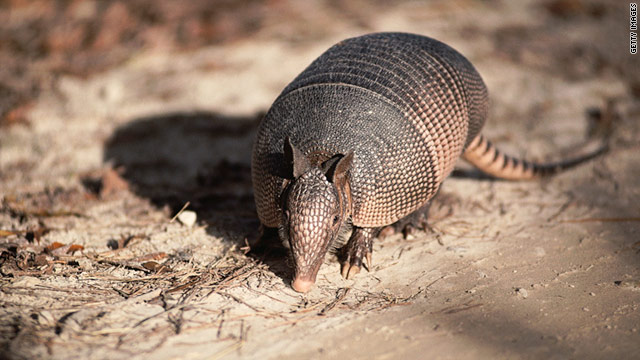
A new study in the New England Journal of Medicine may provide an explanation for her case: armadillos. The leathery shelled mammals, which can be found in 10 states throughout the Southeastern U.S., are the only animals besides humans known to carry leprosy.
There have been several anecdotal reports of leprosy in humans who have handled, killed or eaten armadillos, or who may have been indirectly exposed by gardening in soil where the animals burrow, as was the case for Abide's patient.
But until now, experts haven't been able to confirm that armadillos could pass the disease to humans. The study provides the strongest evidence to date. Researchers analyzed the genomes of leprosy-causing bacteria collected from seven patients and one armadillo.
After identifying specific strains of the bacteria, they compared them with a larger group of infected people and armadillos from around the world.
Health.com: Stay safe in the backyard
Of the 50 patients and 33 wild armadillos the researchers analyzed from the U.S., 25 patients and 28 armadillos shared a genetically identical strain of leprosy bacteria. And at least 8 of the 25 patients carrying the strain reported contact with armadillos.
"It's difficult to demonstrate specific causality," says Richard Truman, Ph.D., one of the study authors and the chief of microbiological research at the National Hansen's Disease Program, in Washington, D.C. (Leprosy is also known as Hansen's disease.)
However, he adds, the chance that the humans with the armadillo-specific strain were infected by some other means is about 1 in 10,000. The armadillo population in the U.S. has been estimated at 30 to 50 million, and studies suggest that, in some places, up to 15 percent have leprosy.
For now the infected animals are concentrated in Texas, Louisiana, Mississippi, Arkansas, and Alabama, but the armadillo population appears to be spreading north and east and could bring leprosy with it.
Health.com: 20 medical mysteries and miracles
Truman says that people in those areas may eventually see a minor increase in risk, but so far leprosy has not been detected in animals on the East Coast.
"Leprosy is a rare disease and will remain a rare disease," he says. Still, doctors should be on the lookout for signs of the disease, says James Krahenbuhl, Ph.D., director of the National Hansen's Disease Program. "Most physicians are unaware that leprosy even exists in the U.S., and they miss the diagnosis."
Leprosy usually becomes a chronic disease, Krahenbuhl explains, but it can be cured if it is treated with multiple drugs in the early stages, when the disease has only caused skin lesions. Left untreated, it can progress to nerve damage in some patients.
Health.com: I survived dengue fever
Abide suspects that new cases of leprosy in the U.S. are underreported, because the early signs can be easy for patients and doctors to overlook until decades later, when more serious symptoms appear.
"It kind of makes me wonder, as subtle as it is, if I'm missing something," he says. Up to 30 percent of residents in the rural area he serves have been in contact with armadillos, Abide estimates.
He urges his patients not to touch, handle, or eat the animals, and to steer clear of souvenirs made from armadillo carcasses, which are popular in Texas. The new study should help raise awareness, he says.
When he tells his patients that armadillos cause leprosy, he explains, "They kind of look at me like I'm crazy."
Copyright Health Magazine 2010
April 26, 2011 10:00 p.m. EDT Ashes from Tungurahua, seen here in a 2010 photo, rose more than four miles into the air Tuesday.STORY HIGHLIGHTS
- Ash rises more than 7 kilometers in the air above the volcano
- Ecuador's geophysics institute says damage to farms and health are evident
- The volcano has erupted periodically since 1999
- Tungurahua means "throat of fire" in the native Quechua language
(CNN) -- Authorities in Ecuador closed schools and evacuated residents in areas near a volcano Tuesday after ashes spewing from its crater fell on homes and farms, state media reported.
Ashes from Tungurahua -- which means "throat of fire" in the native Quechua language -- rose more than 7 kilometers (4 miles) into the air Tuesday, the government news agency said.
Authorities issued an alert as monitors detected six eruptions, ranging from moderate to large, and a significant ash cloud Tuesday, state media said.
"According to our observations, damages to crops, pastures and small effects to the health of people are already evident," the country's geophysics institute said.
Officials first detected increased activity in the volcano April 20, with monitors observing regular small eruptions of ash and gas.
The glacier-capped, 16,478-foot volcano has erupted periodically since 1999, when increased activity led to the temporary evacuation of the city of Banos at the foot of the volcano.
Tungurahua erupted in December, sending ash and lava spewing nearly a mile into the sky.
Major eruptions also occurred in August 2006 and February 2008, according to the government's emergency management agency.
Before the recent activity, the last major eruption was between 1916 and 1918. Relatively minor activity continued until 1925, the Smithsonian Institution said on its volcano website.
The volcano is 140 kilometers (86 miles) south of Quito, Ecuador's capital.
When "Goodnight Moon" just isn't cutting it... one dad and novelist has written a bedtime story to warm the hearts of sleep-deprived parents everywhere: "Go the F@#k to Sleep."
By Kristin Kalning, TODAY Moms contributor

Most parents can recall a particularly dark and dreadful night when their little one just wouldn’t go to sleep. And most parents have uttered -- in their heads, or under their breath – a frustrated profanity about it. Novelist and dad Adam Mansbach did one better: He wrote a children’s book called "Go the F--- to Sleep."
Here’s a sample:
“The cats nestle close to their kittens.
The lambs have laid down with the sheep.
You're cozy and warm in your bed, my dear
Please go the f@#k to sleep.”
Now before you call Child Protective Services, let’s be clear: This book is written and illustrated in the tradition of a child’s bedtime book, but it’s not at all meant for kids. (It says so on the back cover.) The book, which alternates lilting verse with, well, profane reality, is aimed squarely at parents.
“Hopefully, the book is very reflective of what we all feel putting our kids to bed,” Mansbach told TODAY Moms. “We all love our kids – it’s not like we stop loving our kids – but as the minutes tick by, we’ll do anything to get out of that room.”
Mansbach isn’t just another foul-mouthed, wannabe writer – he’s an acclaimed and accomplished author. He’s a visiting professor of fiction at Rutgers University.
But as any good fiction teacher will tell you, you’ve gotta write what you know. And last summer, Mansbach knew that it was taking for-freaking-ever to get his 2-year-old daughter, Vivien, to go the f@#ck to sleep. He posted an exasperated lament on Facebook, and his friends told him to write a book. So he did.
“Go the F@#k to Sleep” just went to print, so I got a personal, over-the-phone reading from the author. It’s laugh-out-loud funny, capturing perfectly the seemingly endless bedtime routine all parents have endured: the requests for one more story, a glass of water, another bathroom trip, a different teddy bear. It juxtaposes the sweet words we say to our kids on such a night with what we’re really thinking in our heads.
Mansbach hopes people will not only relate to the book, but get some relief from it, too. Despite the “tremendous culture of parenting,” there’s a lot that doesn’t get talked about, he said.
“Hopefully, the honesty of this book will open up the conversation. These are legitimate ways that we feel, and we should laugh about it, and be honest about these tribulations.”
These days, Mansbach’s daughter is a pretty darned good sleeper. “I would like to think that writing this book solved her sleep problems,” he said with a laugh.
“Go the F@#k to Sleep,” from Akashic Books, comes out on Oct. 11. It’s already in the top 300 on Amazon.
via moms.today.com
If you don’t want it to get even harder for a U.S. citizen to get a passport — now required for travel even to Canada or Mexico — you only have until Monday to let the State Department know.The U.S. Department of State is proposing a new Biographical Questionnaire for some passport applicants: The proposed new Form DS-5513 asks for all addresses since birth; lifetime employment history including employers’ and supervisors names, addresses, and telephone numbers; personal details of all siblings; mother’s address one year prior to your birth; any “religious ceremony” around the time of birth; and a variety of other information. According to the proposed form, “failure to provide the information requested may result in … the denial of your U.S. passport application.”
The State Department estimated that the average respondent would be able to compile all this information in just 45 minutes, which is obviously absurd given the amount of research that is likely to be required to even attempt to complete the form.It seems likely that only some, not all, applicants will be required to fill out the new questionnaire, but no criteria have been made public for determining who will be subjected to these additional new written interrogatories. So if the passport examiner wants to deny your application, all they will have to do is give you the impossible new form to complete.
It’s not clear from the supporting statement, statement of legal authorities, or regulatory assessment submitted by the State Department to the Office of Management and Budget (OMB) why declining to discuss one’s siblings or to provide the phone number of your first supervisor when you were a teenager working at McDonalds would be a legitimate basis for denial of a passport to a U.S. citizen.
There’s more information in the Federal Register notice (also available here as a PDF) and from the Identity Project.
You can submit comments to the State Dept. online at Regulations.gov until midnight Eastern time on Monday, April 25, 2011. Go here, then click the “Submit a Comment” button at the upper right of the page. If that link doesn’t work for you, it’s probably a problem with the javascript used on the Regulations.gov website. There are alternate instructions for submitting comments by email here.
(Note that the proposed form itself was not published in the Federal Register. The Identity Project was eventually provided with a copy after requesting it from the Department of State, and posted it here.)
Here’s a draft of the comments (PDF) being submitted by the Consumer Travel Alliance and other consumer, privacy, and civil liberties groups and individuals, if you would like to use it for ideas for comments of your own. (It’s also available in OpenOffice format for easier editing.)
Extra points to the person who gives the best answer in the comments to the question on the proposed form, “Please describe the circumstances of your birth including the names (as well as address and phone number, if available) of persons present or in attendance at your birth.”
By - Apr 26, 2011 12:50 PM CT
Forest Laboratories Inc. (FRX) Chairman and Chief Executive Officer Howard Solomon, whose company paid $313 million to settle a U.S. fraud case last year, is the latest pharmaceutical executive facing a ban from doing business with federal health programs.
Forest and Solomon were notified of the action in an April 12 letter from the Office of Inspector General at the Department of Health and Human Services, the New York-based drugmaker said in a statement. Former KV Pharmaceutical Co. (KV/A) Chief Executive Officer Marc Hermelin resigned as a director last year after he became the first drug-company owner or executive barred from doing business with Medicare, the U.S. health plan for the elderly and disabled, and Medicaid, the program for the poor.
The exclusions are part of a broader effort to make executives and owners more accountable for companies’ actions and reduce fraud in the U.S. health programs, regulators announced last year. The Department of Health and Human Services has had the authority to ban company officials since 1996 and has moved against 28 individuals since then, the agency said in November.
“It would be completely unwarranted to exclude a senior executive against whom there has never been any allegation of wrongdoing whatsoever,” William Candee III, a Forest director, said in the company’s April 13 statement. “We are hopeful that HHS-OIG will decide that the facts and circumstances as to Mr. Solomon do not warrant an exercise of its exclusion authority.”
Solomon has 30 days from receipt of the letter to respond and plans to contest the regulator’s effort to forbid him from doing business with the health programs, Forest said in its statement.
Dual Effort
The HHS inspector general’s office issued guidelines last October about how it planned to use its power to pursue company executives in fraud cases. Eric Blumberg, deputy chief for litigation at the Food and Drug Administration, said at the same time that regulators also would begin using their legal powers to exclude executives when companies were convicted of so-called off-label marketing in which a drug is promoted for an unauthorized use.
Frank Murdolo, Forest vice president of investor relations, didn’t respond to a voice message requesting an interview. Hugh Burns of the public-relations firm Sard Verbinnen & Co. in New York, which represents the drugmaker, declined to comment. Donald White, a spokesman for the HHS inspector general’s office, also declined to comment.
By Allen G. Breed
ORACLE, Ariz. — Jane Poynter and seven compatriots agreed to spend two years sealed inside a 3-acre terrarium in the Sonoran Desert. Their mission back in the 1990s: To see whether humans might someday be able to create self-sustaining colonies in outer space.
Two decades later, the only creatures inhabiting Biosphere 2 are cockroaches, nematodes, snails, crazy ants and assorted fish. Scientists are still using the 7.2-million-square-foot facility, only now the focus is figuring out how we'll survive on our own warming planet.
Next month, workers will begin a new chapter for "B2" — building the first of three enclosed soil slopes in what was once the "intensive agricultural biome," the space where Poynter and the other original "biospherians" grew the rice, sorghum, peanuts, bananas, papayas, sweet potatoes and lablab beans that supplied 90 percent of their nutritional needs.
The new "Land Evolution Observatory" — a 10-year, $5 million project — will help scientists learn how vegetation, topography and other factors affect rainwater's journey through a watershed and into our drinking supplies.
"What makes me really happy is that it really does capture a lot of what we were trying to do in the early years of Biosphere 2," says Poynter, who founded an aerospace company with husband and fellow biospherian Taber MacCallum. "I mean, they're doing some world-class science. They really have the vision of the place. They understand what it was intended for in many ways."
And researchers say Biosphere 2 may be even more relevant today than when those first people passed through the airlocks on Sept. 26, 1991.
Located about 30 miles northeast of Tucson in the foothills of the Santa Catalina Mountains, B2 rises out of the high-desert landscape like a giant glass-and-steel ziggurat.
In a story previewing that first mission in 1991, the New York Times described Biosphere 2 — Earth is "Biosphere 1" — as a "combination greenhouse and futuristic shopping mall." But with its network of interconnected domed chambers and observatory-topped tower, anchored by the 91-foot-high pyramid and its 6,500 double-laminated windows, the complex resembles nothing so much as one of those plastic Habitrails you kept your hamsters and gerbils in as a kid.
Which is apt, since Poynter and the other biospherians — four men and four women — were very much human Guinea pigs.
Co-founded by counterculture ecologist John Polk Allen and Edward Perry Bass, the billionaire Texas environmentalist who put up the initial $30 million bankroll, Biosphere 2 was described variously as an example of "vision and courage" and, as Ecology magazine put it, "New Age drivel masquerading as science."
The facility at SunSpace Ranch contained five distinct ecosystems, or "biomes": A mangrove wetland, tropical rain forest, savanna grassland, coastal fog desert, and a 600,000-gallon "ocean" with its own wave-lapped sand beach and living coral reef. All told, nearly 4,000 species of animals and plants lived there.
Passing through the first submarine door into the ocean biome, eyeglasses and camera lenses immediately fog up. In the rain forest, mist wafts from the walls. Tiny snails, crawling out onto paths, sometimes get crunched underfoot. Vines snake along support trusses, and a thick canopy of tropical foliage nearly blocks out the sun in places.
The building itself — with its network of 52 tanks that collected up to 5,000 gallons of water from the air each day and "rained" it back into the various biomes, and two massive domed "lungs" that kept the airtight building from exploding or imploding as outside temperatures fluctuated from below freezing to more than 120 degrees — was an engineering marvel.
But it wasn't long before the biospherians began experiencing serious problems.
First, just a couple of weeks into the mission, Poynter — manager of field agricultural crops — sliced off the tip of her left middle finger in a rice hulling machine. When inside attempts at reattachment failed, Poynter reluctantly left the B2 briefly for surgery — but still lost the fingertip.
Project officials had boasted that B2 was more airtight than the space shuttle. But by December, tests showed significant leakage, and outside air had to be pumped in.
Over time, oxygen levels inside B2 had dropped to dangerous levels, while carbon dioxide spiked. Poynter and the others were experiencing lethargy, shortness of breath, sleep apnea and "mood swings."
"The chemistry of the atmosphere was all whacked out," says Joaquin Ruiz, dean of UA's College of Science. "Tonight Show" host Jay Leno, who made B2 a running gag, had an explanation.
"Any kid'll tell you you can't keep eight scientists in a giant mayonnaise jar unless you put holes in the top of the thing."
There were explosions in the cockroach and ant populations. The coral reef died. And then there were revelations that a carbon dioxide scrubber had been installed — belying the notion that the plants would keep the air pure — and that the facility had been stocked with outside food.
Biosphere 2 had a 100-year business model — 50, two-year missions. But after one more group of eight finished its two-year tour in 1994, the live-in phase at B2 was over.
Columbia University became B2's "managing university partner" in 1996 and began manipulating carbon dioxide levels in the now "flow-through" system to study global warming. Columbia left in 2003, and nothing much went on there until June 2007, when Arizona became the "managing university partner."
In a way, B2 itself has been recycled. Everywhere you look, there are experiments going on.
In one current project, researchers from a German company have draped green and white blankets bristling with solar panels over a series of old mine "tailings — the elongated debris piles that surround B2 and snake through the Southwest. Such arrays already allow B2 to go "off the grid" if necessary, and the hope is they may someday dot the landscape, serving the dual purpose of preventing erosion and producing clean, renewable energy.
All water inside B2 was once recirculated and reused. These days, the facility works on a one-path system, says Matt Adamson, senior education and outreach coordinator.
The Associated Press"Because we'll often introduce an isotope into the water for research purposes, and so we don't want to recycle and then reread that data over again."
They're even studying B2 itself, which, aside from the odd cracked window pane or spot of surface rust, looks pretty good for its age.
"Biosphere was completely over-engineered," using first-rate materials, says Ruiz.
Adamson says researchers are in the middle of a survey of all plant life inside Biosphere 2, which will then be compared against the original planting charts. They've already found one species of palm-like cycad — Zamia fischeri — that is now endangered in the outside world.
"Some people imagine a scenario where Biosphere might almost be an ark of plants," Adamson says as he passes a prehistoric-looking tree that stretches almost to the glass ceiling. "As they potentially become endangered in the real world, we'll have viable, healthy specimens in here."
But of all the experiments going on there, "LEO" is the star.
Each of the small watersheds — measuring about 18 meters wide by 30 meters long — will contain tons of "naive soil" (previously unexposed to the elements) mined near Flagstaff and ground to scientists' specifications, says B2 director Travis Huxman. Researchers will be able to alter the conditions inside each chamber and control the conditions to which each slope is exposed.
"Our understanding of how ecosystems are coupled to the atmosphere, how they're driven by climate, I mean, these are all issues that we absolutely have to deal with — right now," says Huxman, a professor of ecology and evolutionary biology at Arizona. "Biosphere 2's just become more and more relevant to that science through time. We don't have the capability to do this anywhere else."
And, as it has been from the beginning, B2 is a major tourist attraction.
About 100,000 visitors a year make the journey out to Oracle. Many, like Web designer Lisa Gray of Newport, Ore., were unaware that the biospherian era had ended.
"I thought that the people were still living here, and that the experiment was still ongoing," says Gray, who toured the facility one recent day with her wife, Kelly Everfree, and their 6-year-old son, Orion.
As the 20th anniversary of that first closed mission approaches, university officials are trying to keep things in perspective.
"We need to be careful that people do understand that what's going on there now is really serious research," says Ruiz. "In the end, simply put, when they sealed themselves in there, it was an experiment that failed."
Poynter, chairwoman and president of Tucson-based Paragon Space Development Corp., bristles at such talk.
"I just am so SICK of that sort of snarky way that a lot of people talk about the Biosphere in its early years," says Poynter, who still visits B2 often and sometimes leads tours. "The fact is that we built this unbelievable place that no one had ever done before. ... We were a very forward-thinking, very unusual group of people — pulled off an unbelievable feat. But, somehow, the unbelievable feat gets lost in the rest of the story."
If the outcome had been preordained, she points out, it wouldn't have been an experiment. If something doesn't work, you learn from it.
So what did she learn from her experience inside the bubble?
"Humans are NOT built to be enclosed," she says with a guffaw. "It is NOT a regenerative process."
___
Allen G. Breed is a national writer for The Associated Press. He can be reached at features(at)ap.org.

NEW YORK (AP) -- Phoebe Snow, a bluesy singer, guitarist and songwriter who had a defining hit of the 1970s with "Poetry Man" but then largely dropped out of the spotlight to care for her disabled daughter, has died.
Snow, who was nominated for best new artist at the 1975 Grammys, died Tuesday morning in Edison, N.J., from complications of a brain hemorrhage she suffered in January 2010, said Rick Miramontez, her longtime friend and public relations representative. She was 60.
Snow's manager, Sue Cameron, said the singer endured bouts of blood clots, pneumonia and congestive heart failure since her stroke.
"The loss of this unique and untouchable voice is incalculable," Cameron said. "Phoebe was one of the brightest, funniest and most talented singer-songwriters of all time and, more importantly, a magnificent mother to her late brain-damaged daughter, Valerie, for 31 years. Phoebe felt that was her greatest accomplishment."
Known as a folk guitarist who made forays into jazz and blues, Snow put her stamp on soul classics such as "Shakey Ground," "Love Makes a Woman" and "Mercy, Mercy Mercy" on over a half dozen albums.
Not long after Snow's "Poetry Man" reached the Top 5 on the pop singles chart in 1975, her daughter, Valerie Rose, was born with severe brain damage, and Snow decided to care for her at home rather than place her in an institution.
"She was the only thing that was holding me together," she told the San Francisco Chronicle in 2008. "My life was her, completely about her, from the moment I woke up to the moment I went to bed at night."
Valerie, who had been born with hydrocephalus, a buildup of fluid in the brain cavity that inhibits brain development, was not expected to live more than a few years. She died in 2007 at age 31.
Over the years, Snow found time to sing on Paul Simon's song "Gone at Last" and tour with him, as well as perform at the Woodstock 25th anniversary festival in 1994, as part of a soul act that included Thelma Houston, Mavis Staples and CeCe Peniston.
Snow was also recruited by Steely Dan's Donald Fagen to participate in the New York Rock and Soul Revue, which took her, Charles Brown, Michael McDonald, Boz Scaggs and others on tour and into New York's Beacon Theatre to record a rollicking live album in 1991.
"Occasionally I put an album out, but I didn't like to tour, and they didn't get a lot of label support," she told the Chronicle. "But you know what? It didn't really matter because I got to stay home more with Valerie, and that time was precious."
She was born Phoebe Ann Laub to white Jewish parents in New York City in 1952, and raised in Teaneck, N.J. Though many assumed she was black, Snow never claimed African-American ancestry.
She changed her name after seeing Phoebe Snow, an advertising character for a railroad, emblazoned on trains that passed through her hometown. Snow quit college after two years to perform in amateur nights at Greenwich Village folk clubs.
Her first record, "Phoebe Snow," came out in 1974, and showed off her songwriting chops on a selection of tunes that spanned blues, jazz and folk. Hit-bound "Poetry Man" took the record to No. 4 on the album charts, but her success was uneasy.
"There are turning points in everyone's life where you decide if you're going to sink or swim. My insecurity wasn't serving me well at all. It was really a stumbling block," she told The Associated Press in 1989.
Rumors abounded that Jackson Browne was Poetry Man. "No, no. It's somebody you wouldn't know. People just thought Poetry Man was Browne because he was the first act I toured with," Snow told USA Today in 1989.
After 1976's gold-selling "Second Childhood," Snow's subsequent albums found smaller audiences. Through the 1980s and into the 1990s, Snow sang commercial jingles - for companies including Michelob, Hallmark and AT&T - and performed live here and there.
Inexperienced in the music business, she broke a number of contracts with record companies and others, and found herself embroiled in a number of lawsuits and severe financial problems. Snow's husband, musician Phil Kearns, left her while Valerie was still a baby.
She sang the theme for NBC's "A Different World" and the jingle "Celebrate the Moments of Your Life" for General Foods International Coffees. She also sang at radio host Howard Stern's wedding to Beth Ostrosky in 2008 and for President Bill Clinton, who asked her to perform at Camp David during his presidency.
In 2003, she released the CD "Natural Wonder," her first album of new, original material in 14 years. Her other albums include 1989's "Something Real," and 1981's "Rock Away." In 2008, she released a live album titled "Live" and a best-of CD in 2001.
AP
Aug. 7, 2010: An amateur photographer takes a picture in the assembly room of the elements of the LHC (large hadron collider) during the Particle Physics Photowalk at the European Particle Physics laboratory (CERN) in Geneva, Switzerland.
The news was simply too exciting to keep under wraps: A Swiss particle accelerator may have found a long-sought subatomic bit called the Higgs Boson -- something never before seen, but thought to be the fundamental unit of matter. It's called the "God Particle" because it is the one thing that lends mass to all other stuff.
But is it too good to be true? Or merely blabbering physicists, battling it out for a spot in the public eye?
The controversial rumor is based on a leaked internal note from physicists at the Large Hadron Collider (LHC), a 17-mile-long particle accelerator near Geneva that sits on the sharpest part of the cutting edge of science. The note details an unexpected "bump" in emissions that may be proof of the long-sought particle.
If the find is true, it's a game changer for science, explained Dmitri Denisov, a physicist with Fermilabs in Illinois.
"I would compare it to the discovery of electricity," he told FoxNews.com.

Sau Lan Wu, the Enrico Fermi professor of physics at the University of Wisconsin, Madison, and one of the controversial memo's authors, told FoxNews.com she couldn't speak further about the discovery -- not yet, anyway.
But two weeks earlier, scientists at the Tevatron atom smasher at Fermilab in Illinois heralded their own discovery: a new particle, also evidenced by a "bump" in the data.
Sound familiar?
The Tevatron bump and the CERN bump aren't connected, however, said Rob Roser, staff scientist at Fermilab. He pointed out that the two colliders work in different ways, one smashing protons and antiprotons, the other colliding protons with other protons. But Roser was unsurprised that Wu had made such a startling claim.
"She's very aggressive, shall we say," he told FoxNews.com
Roser said Wu's team has been on a lengthy quest for the Higgs Boson, ever since CERN shuttered her old project -- the aging Large Electron Positron Collider II. Just before that project ended, Wu claimed a similar discovery, Roser said.
"She didn't just happen on this, she's been pushing hard on the data sets and pushing to understand the simulations for quite a while," he told FoxNews.com.
Tommaso Dorigo, an experimental particle physicist who works with both atom smashers, blogged about Wu's discovery on Friday. He shared the same suspicions as Roser, noting that Wu was "among those less happy of the decommissioning of LEP II at the time when they were claiming a possible Higgs signal."
"Maybe these guys have been looking for some confirmation of the 115 GeV Higgs all along," he wrote. Dorigo did not respond to FoxNews.com requests for more information.
James Gillies, a spokesman for CERN, explained that the leaked note faces several layers of scrutiny before it could be submitted for publication. "Things such as this show up quite frequently in the course of analysis," he told FoxNews.com.
"It's way too soon to get excited, I'm afraid," he said. "It's not the physics find of the millennium, unfortunately."
WHAT IS A 'HIGGS BOSON'?
Isn't mass just inherent in stuff? How could one particle be responsible for the mass of another? Physicists believe the Higgs does just that -- and an analogy at the Exploratorium website explains the concept nicely.
"Imagine you're at a Hollywood party. The crowd is rather thick, and evenly distributed around the room, chatting. When the big star arrives, the people nearest the door gather around her. As she moves through the party, she attracts the people closest to her, and those she moves away from return to their other conversations.
"By gathering a fawning cluster of people around her, she's gained momentum, an indication of mass. She's harder to slow down than she would be without the crowd. Once she's stopped, it's harder to get her going again."
INSIDE THE LARGE HADRON COLLIDER
True or not, you have to be amazed by everything about the LHC, the world's largest and most powerful particle accelerator.
The collider is a 17-mile looped tunnel designed to create "mini-Big Bangs" by smashing together particles. Inside the tunnel, essentially a massive donut that sits on the border between France and Switzerland, two beams of light are shot in either direction and accelerated with magnets to nearly the speed of light.
In order for the superconducting magnets to work at maximum efficiency, they are chilled to 519 degrees Farenheit -- colder than outer space. This means the LHC is also the world's largest refrigerator, the CERN website points out.
To record the incredibly fast and incredibly tiny collisions of hundreds of thousands of particles, there are several giant detectors -- essentially super high-speed cameras recording millions of data points per second. But because the Large Hadron Collider will produce roughly 15 petabytes (15 million gigabytes) of data annually, ordinary connections wouldn't be capable of transmitting all of that data fast enough.
To store all of the information coming out of the machine, the detectors are tied into a next-generation computer network called The Grid, a superfast network of fiber optic cables just to carry all that information.
VIENNA – A man turning dirt in his back yard stumbled onto buried treasure — hundreds of pieces of centuries-old jewelry and other precious objects that Austrian authorities described Friday as a fairy-tale find.
Austria's department in charge of national antiquities said the trove consists of more than 200 rings, brooches, ornate belt buckles, gold-plated silver plates and other pieces or fragments, many encrusted with pearls, fossilized coral and other ornaments. It says the objects are about 650 years old and are being evaluated for their provenance and worth.
While not assigning a monetary value to the buried bling, the enthusiastic language from the normally staid Federal Office for Memorials reflected the significance it attached to the discovery.
"Fairy tales still exist!" said its statement. "Private individual finds sensational treasure in garden."
It described the ornaments as "one of the qualitatively most significant discoveries of medieval treasure in Austria."
Click image to see photos of buried treasure
AP/Bundesdenkmalamt/Bettina Sidonie, HandoutThe statement gave no details and an automated telephone message said the office had closed early on Good Friday. But the Austria Press Agency cited memorials office employee Karin Derler as saying the man came across the "breathtaking" objects years ago while digging in his back yard to expand a small pond.
The weekly Profil magazine identified the man only as Andreas K. from Wiener Neustadt, south of Vienna, and said he asked not to be named.
While he found the ornaments in 2007, Andreas K. did not report it to the memorials office until after rediscovering the dirt-encrusted objects in a basement box while packing up after selling his house two years ago, said Profil. The soil had dried and some had fallen off, revealing precious metal and jewels underneath.
He initially posted photos on the Internet, where collectors alerted him to the potential value of the pieces, leading him to pack them in a plastic bag and lug them to the memorials office, the magazine said in its Friday edition.
Neither Profil nor the memorials office statement said when Andreas K. first alerted Austrian authorities and it was unclear why they waited until Friday to announce the discovery.
Memorials office president Barbara Neubauer told Profil the objects were a "sensational find."
The magazine said the finder was not interested in cashing in on the trove and was considering loaning the collection to one of Austria's museums.
(CNN) -- A strong tornado damaged parts of an airport in St. Louis when it hit Friday, officials said.
The National Weather Service said authorities believe the tornado was on the ground for several miles and observed the twister from a tower at Lambert-St. Louis International Airport.
The tornado damaged a terminal and parts of the airport's Concourse C, which is used by American Airlines, AirTran and Cape Air, airport spokesman Jeff Lea said.
Some people were injured, he said.
The tornado was near Ferguson, Missouri, later Friday night, the National Weather Service said.
CNN's Taylor Ward and Greg Morrison contributed to this report.
AP
Aug. 7, 2010: An amateur photographer takes a picture in the assembly room of the elements of the LHC (large hadron collider) during the Particle Physics Photowalk at the European Particle Physics laboratory (CERN) in Geneva, Switzerland.
A rumor is floating around the physics community that the world's largest atom smasher may have detected a long-sought subatomic particle called the Higgs boson, also known as the "God particle."
The controversial rumor is based on what appears to be a leaked internal note from physicists at the Large Hadron Collider (LHC), a 17-mile-long particle accelerator near Geneva, Switzerland. It's not entirely clear at this point if the memo is authentic, or what the data it refers to might mean — but the note already has researchers talking.
The buzz started when an anonymous commenter recently posted an abstract of the note on Columbia University mathematician Peter Woit's blog, Not Even Wrong.
Some physicists say the note may be a hoax, while others believe the "detection" is likely a statistical anomaly that will disappear upon further study. But the find would be a huge particle-physics breakthrough, if it holds up.
"If it were to be real, it would be really exciting," said physicist Sheldon Stone of Syracuse University.
Hunting for the HiggsThe Higgs boson is predicted to exist by prevailing particle-physics theory, which is known as the Standard Model. Physicists think the Higgs bestows mass on all the other particles — but they have yet to confirm its existence.
Huge atom smashers — like the LHC and the Tevatron, at Fermilab in Illinois — are searching for the Higgs and other subatomic bits of matter. These accelerators slam particles together at enormous speeds, generating a shower of other particles that could include the Higgs or other elemental pieces predicted by theory but yet to be detected. [Wacky Physics: The Coolest Little Particles in Nature]
The leaked note suggests that the LHC's ATLAS particle-detection experiment may have picked up a signature of the elusive Higgs. The signal is consistent, in mass and other characteristics, with what the Higgs is expected to produce, according to the note.
However, some other aspects of the signal don't match predictions.
"Its production rate is much higher than that expected for the Higgs boson in the Standard Model," Stone told SPACE.com in an email interview. So the signal may be evidence of some other particle, Stone added, "which in some sense would be even more interesting, or it could be the result of new physics beyond the Standard Model."
Too soon to tell
Stone was quick to point out that the note is not an official result of the ATLAS research team. Therefore, speculating about its validity or implications is decidedly preliminary.
"It is actually quite illegitimate and unscientific to talk publicly about internal collaboration material before it is approved," Stone said. "So this 'result' is not a result until the collaboration officially releases it."
Other researchers joined Stone in urging patience and caution before getting too excited about the possible discovery.
"Don't worry, Higgs boson! I would never spread scurrilous rumors about you. Unlike some people," Caltech physicist Sean Carroll tweeted today (April 22).
While it's still early, some researchers have already begun to cast doubt on the possible detection. For example, Tommaso Dorigo — a particle physicist at Fermilab and CERN, which operates the LHC — thinks the signal is false and will fade upon closer inspection.
Dorigo — who said he doesn't have access to the full ATLAS memo — gives several reasons for this viewpoint. He points out, for example, that scientists at Fermilab didn't see the putative Higgs signal in their Tevatron data, which covered similar ground as the ATLAS experiment.
Dorigo feels strongly enough, in fact, to put his money where his mouth is.
"I bet $1,000 with whomever has a name and a reputation in particle physics (this is a necessary specification, because I need to be sure that the person taking the bet will honor it) that the signal is not due to Higgs boson decays," he wrote on his blog today. "I am willing to bet that this is NO NEW PARTICLE. Clear enough?"
LUCKNOW, India (AP) -- It was an all you can eat buffet at the bank.
An army of termites munched through 10 million rupees ($222,000) in currency notes stored in a steel chest at a bank, police in northern India said Friday.
The bank manager discovered the damage when he opened the reinforced room in an old bank building on Wednesday, police officer Navneet Rana told The Associated Press.
"It's a matter of investigation how termites attacked bundles of currency notes stacked in a steel chest," he said. The money was put in the chest in January.
The termites had damaged bank furniture and documents in the past.
The police have registered a case of negligence against bank officials in Barabanki, a town 20 miles (30 kilometers) southwest of Lucknow, the Uttar Pradesh state capital. In India, police register a case before opening an investigation.
Amazon servers take down Reddit, Foursquare, and more
Popular link-sharing site Reddit is down, location-based social network Foursquare is down, URL shortener ow.ly is down, application hosting service Cydia is down — every few clicks and we discover a site that's down. What is going on?
It turns out that Amazon's servers are to blame.
The Atlantic Wire reports that Amazon's EC2 Web-hosting service — something on which many popular sites and services rely — suffered some sort of technical problem which took some of our favorite Internet destinations off the map:
While most people think of Amazon as the world's biggest online retailer it's also the world's biggest cloud-computing provider. So when its servers went down, it took Reddit, Foursquare, Quora and Hootsuite down with it.
The reason so many sites choose Amazon is because its hosting fees are some of the cheapest around. Many, if not most, companies rely on third parties to run their servers. But the proliferation of companies relying on Amazon's hosting service shows how a hiccup can turn into a storm.
Based on a continually updated list being maintained by Arik Hesseldahl of All Things D, the following sites and services have experienced or are still experiencing issues as a result of the Amazon server situation:
- Foursquare
- Quora
- Hootsuite
- ow.ly
- SCVNGR
- Discovr
- Wildfire
- Livefyre
- CampgroundManager
- Totango
- ESchedule
- ZeHosting
- Recorded Future
- PercentMobile
- The Cydia Store
We've reached out to Amazon for a statement regarding what exactly happened and will update once we know more about the situation, but in the meantime will trust a status message which states that the Web-hosting provider is "continuing to work on resolving this issue."
kdvr-fire-forces-evacuation-of-shopping-mall-20110420LITTLETON, Colo. -- FOX31 News has learned that the FBI is holding a "person of interest" in Wednesday’s attempted bombing at Southwest Plaza mall, though the name of the person has yet to be released.
The first device was found at about 11:50 a.m. when a mall employee noticed a fire in a hallway near the food court, the witness told FOX31 News. He immediately contacted security officers who began evacuating the sprawling indoor shopping center at Wadsworth & Bowles.He said the device was attached to two camping propane tanks, neither of which exploded.
The Jefferson County Bomb Squad responded and later found a pipe bomb in the same hallway, Jefferson County spokeswoman Jackie Kelley said.
When crews tried to explode the propane bomb using a remote-controlled robot, it appeared to fall apart and any detonation became unnecessary.
Kelley refused to elaborate on the level of sophistication involved in the bombs' designs.
“We obviously have a suspect who is still at large. We have a case that we want to prosecute and an arrest we want to make, so we’re going to be a little tight lipped around that,” Kelley said earlier in the afternoon.
The mall was to remain closed for the remainder of the night.
The Federal Bureau of Investigation confirms that it is assisting in the investigation, but would not immediately classify this as a case of domestic terrorism.
“It's too early to speculate," FBI spokesman Dave Joly told FOX31 News. He said the devices could have caused “serious" damage, if they had detonated.
More than two dozen Jefferson County schools were placed on lockout as a precaution, meaning there was only one point of entry and exit for each school.
The incident comes on the 12th anniversary of the Columbine High School massacre in which 12 students and one teacher were murdered by two students who eventually took their own lives.
Egypt Archaeology Chief Zahi Hawass to Appeal Jail Term on Bookshop Plan
By - Apr 18, 2011 3:13 AM CT
Zahi Hawass, Egypt’s minister of state for antiquities, said he will appeal a one-year jail sentence imposed on him yesterday.
The sentence is related to a lawsuit accusing him of refusing to carry out a court ruling, the state-run Middle East News Agency said today. The court had ordered a halt to bidding from companies to run a bookstore in the Egyptian Museum in Cairo, Hawass said today in his blog.
“Tomorrow, the head of the legal affairs department at the Ministry of Antiquities will go to the court to file our appeal,” Hawass said in the Web log. “He will present evidence that the bid for the bookstore contract was finished before the original court ruling, so therefore we could not follow the ruling to stop the bidding.”
Egyptian archeologists including Hawass appealed to the government in March to protect the country’s tombs and storehouses from looting following the revolution that ousted President Hosni Mubarak. As well as the theft of artifacts from the Egyptian Museum, storage areas were broken into, including one belonging to the New York Metropolitan Museum of Art’s archaeological expedition in Dahshur, Hawass said on March 3.