Imported fenugreek seeds from Egypt may be the source of highly toxic E. coli outbreaks in Germany and France that have killed at least 48 people, according to initial investigations by European scientists.
More than 4,000 people across Europe and in North America have been infected in the deadliest outbreak of E. coli so far recorded, which started in early May. Almost all of those sickened lived in Germany or had recently travelled there.
The German outbreak and a smaller cluster of E. coli centered around the French city of Bordeaux have both been linked to sprouted seeds.
Experts from the European Center for Disease Prevention and Control (ECDC) and the European Food Safety Authority said initial investigations suggested that "the consumption of sprouts is the suspected vehicle of infection in both the French cluster and the German outbreak.
"The tracing back is progressing and has thus far shown that fenugreek seeds imported from Egypt either in 2009 and/or 2010 are implicated in both outbreaks," they said in a joint statement posted on the ECDC's website late Wednesday.
The European investigators said that since contamination of the seeds could have occurred at any stage in the long and complex supply chain between seed production, transport, packaging and distribution, "this would also mean that other batches of potentially contaminated seeds are still available within the EU (European Union), and perhaps outside."
The strain of E. coli infections in the current outbreaks -- known as STEC O104:H4 -- can cause serious diarrhea and, in severe cases, kidney failure and death.
The ECDC and EFSA said a batch of fenugreek seeds imported from Egypt in 2009 appeared to be implicated in the outbreak in France, and a 2010 batch was "considered to be implicated in the German outbreak."
But they said there was still "much uncertainty" about whether these seeds from Egypt were "truly the common cause of all the infections" as there are currently no positive bacteriological results.
"Until the investigation has been finalized, ECDC and EFSA strongly recommend advising consumers not to grow sprouts for their own consumption and not to eat sprouts or sprouted seeds unless they have been cooked thoroughly," they said.
E. coli bacteria thrive in nutrient-rich environments like the guts of humans or cows. The STEC O104:H4 strain has been found to be particularly sticky, making it likely to be able to cling on to leaves, seeds and other foodstuffs.
Fenugreek is used as a herb, a spice in many types of curry, and for spouting seeds used in salads, and as a garnish.









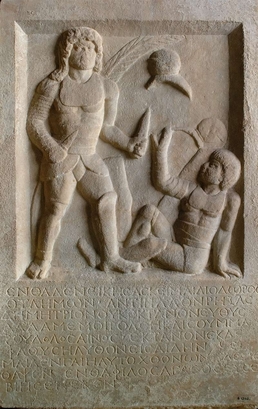
An enigmatic message on a Roman gladiator's 1,800-year-old tombstone has finally been decoded, telling a treacherous tale.
The epitaph and art on the tombstone suggest the gladiator, named Diodorus, lost the battle (and his life) due to a referee's error, according to Michael Carter, a professor at Brock University in St. Catharines, Canada. Carter studies gladiator contests and other spectacles in the eastern part of the http://www.livescience.com/11347-top-10-ancient-capitals.html">Roman Empire.
He examined the stone, which was discovered a century ago in Turkey, trying to determine what the drawing and inscription meant.
His results will be published in the most recently released issue of the Zeitschrift für Papyrologie und Epigraphik(Journal for Papyrology and Ancient Epigraphics).
Tombstones talk
The tombstone was donated to the Musee du Cinquanternaire in Brussels, Belgium, shortly before World War I. It shows an image of a gladiator holding what appear to be two swords, standing above his opponent who is signalling his surrender. The inscription says that the stone marks the spot where a man named Diodorus is buried.
"After breaking my opponent Demetrius I did not kill him immediately," reads the epitaph. "Fate and the cunning treachery of the summa rudis killed me."
The summa rudis is a referee, who may have had past experience as a gladiator.
The inscription also indicates Diodorus was born in and fought in Amisus, on the south coast of the Black Sea in Turkey.
Though Carter has examined hundreds of http://www.livescience.com/6245-mysterious-lead-coffin-rome.html">gladiator tombstones, this "epitaph is completely different from anything else; it's telling a story," he told LiveScience.
The final fight
The story the tombstone tells took place about 1,800 years ago when the empire was at its height, its borders stretching from Hadrian's Wall in England to the Euphrates River in Syria.
Gladiator games were popular spectacles, many of them pitting two men against each other. Although deaths from wounds were common, the battles were not the no-holds-barred fights to the death depicted by Hollywood, said Carter.
"I believe that there are a number of very detailed rules involved in regulating gladiatorial combat," Carter said.
Though the exact rules are not well understood, some information can be gleaned from references in surviving texts and art.
For starters, most, if not all, of the fights were overseen by the summa rudis.
Among the rules he enforced was one in which a http://www.livescience.com/2563-kennedy-clinton-thumbs.html">defeated gladiator could request submission, and if submission was approved by the munerarius (the wealthy individual paying for the show), the contestant could leave the arena without further harm.
Another rule that appears to have been in place was that a gladiator who fell by accident (without the help of his opponent) would be allowed to get back up, pick up his equipment and resume combat.
Death of Diodorus
It's this last rule that appears to have done in Diodorus. Carter interprets the picture of the gladiator holding two swords to be a moment in his final fight, when Demetrius had been knocked down and Diodorus had grabbed a hold of his sword.
"Demetrius signals surrender, Diodorus doesn't kill him; he backs off expecting that he's going to win the fight," Carter said.
The battle appears to be over. However the summa rudis — perhaps interpreting Demetrius' fall as accidental, or perhaps with some ulterior motive — thought otherwise, Carter said.
"What the summa rudis has obviously done is stepped in, stopped the fight, allowed Demetrius to get back up again, take back his shield, take back his sword, and then resume the fight."
This time Diodorus was in trouble, and either he died in the arena or Demetrius inflicted a wound that led to his death shortly thereafter.
This event would have happened before a crowd of hundreds, if not thousands, of people in a theater or in part of an athletic stadium converted into a sort of mini- Colosseum.
After Diodorus was dead, the people who created his tombstone (probably family or friends) were so upset, Carter suggests, that they decided to include some final words on the epitaph:
"Fate and the cunning treachery of the summa rudis killed me."
.jpg)


