Shop Amazon

Showing posts with label China. Show all posts

Friday, September 7, 2012

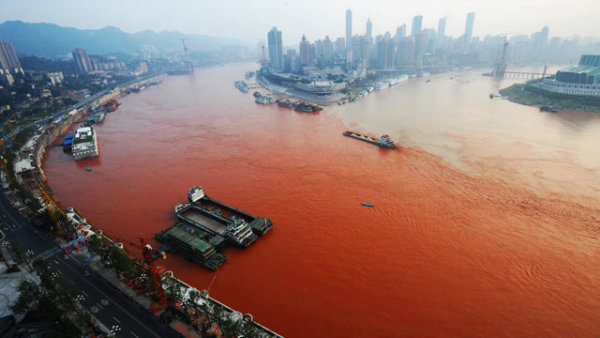
Yangtze River Turns Red and Turns Up a Mystery | ABC News

(ChinaFotoPress/ChinaFotoPress via Getty Images)For a river known as the "golden watercourse," red is a strange color to see.

By 

Yet that's the shade turning up in the Yangtze River and officials have no idea why.

The red began appearing in the Yangtze, the longest and largest river in China and the third longest river in the world, yesterday near the city of Chongquing, where the Yangtze connects to the Jialin River.

The Yangtze, called "golden" because of the heavy rainfall it receives year-round, runs through Chongqing, Southwest China's largest industrial and commercial center, also known as the "mountain city" because of the hills and peaks upon which its many buildings and factories stand.

The red color stopped some residents in their tracks. They put water from the river in bottles to save it. Fishermen and other workers who rely on the river for income kept going about their business, according to the UK's Daily Mail.

While the river's red coloring was most pronounced near Chongqing it was also reported at several other points.

Officials are reportedly investigating the cause.


Sunday, November 13, 2011

Canada eyes Asia after U.S. delays Keystone project | Reuters

Demonstrators carry a giant mock pipeline while calling for the cancellation of the Keystone XL pipeline during a rally in front of the White House in Washington November 6, 2011. REUTERS/Joshua Roberts

HONOLULU | Sun Nov 13, 2011 5:26pm EST

HONOLULU (Reuters) - Canadian Prime Minister Stephen Harper said on Sunday his country will make a bigger push to sell its energy products to Asia after Washington delayed a decision to approve the Keystone XL Canada-to-Texas oil pipeline project.

"This does underscore the necessity of Canada making sure that we are able to access Asia markets for our energy products," Harper told reporters on the sidelines of the Asia-Pacific Economic Cooperation forum.

"That will be an important priority of our government going forward and I indicated that yesterday to the president of China."

The Obama administration recently announced it would study a possible new route for TransCanada Corp's proposed $7 billion pipeline, which could end up killing the project.

Harper reiterated the Canadian government's disappointment and said he remained optimistic the United States would eventually give it the green light.

"It's important to note there has been extremely negative reaction to this decision in the United States," Harper said ahead of a one-on-one meeting with President Barack Obama.

(Reporting by Rachelle Younglai; Editing by John O'Callaghan)

Sunday, July 3, 2011

Huge rare earth deposits found in Pacific: report | Reuters

TOKYO | Sun Jul 3, 2011 8:00pm EDT

TOKYO (Reuters) - Vast deposits of rare earth minerals have been discovered on the seabed of the Pacific Ocean amounting to 1,000 times those on land, media reported on Monday citing a study by Japanese researchers.

The deposits are estimated to amount to 100 billion metric tons, the Nikkei business daily said.

They are believed to lie at a depth of 3,500 to 6,000 meters and cover an area of over 11 million square meters, the reports said.

China, which produces 97 percent of global rare earth supplies, has been tightening trade in the strategic metal, which is used in high-tech electronics, magnets and batteries, causing concerns globally about supply and triggering jumps in prices.

The study by researchers from the University of Tokyo and the Japan Agency for Marine-Earth Science and Technology is to be published on Monday in the online edition of the British science magazine Nature Geoscience, the reports said.

Japan's imports of rare earths from China fell 3 percent in May from April, the first month-on-month drop in three months, as the price of the metal surged, Japan's finance ministry said last month.

Demand could pick up later in the year as Japan continues to recover from the March 11 earthquake.

(Reporting by Kaori Kaneko; Editing by Michael Watson)

Friday, June 10, 2011

HAVE SOME RICE, WITH A LITTLE CANNIBALISM THROWN IN FOR GOOD MEASURE

June 10, 2011 By Joseph P. Farrell

Well, the next time you eat rice, you might want to check whether it comes from Kansas or not, and if so, be on alert you might be eating a family member, so to speak:

USDA Backs Production of Rice With Human Genes

Of course, we’re fed the usual blithering babble from our government, and a “nice” cover story that this is all about preventing diarrhea in children. Pardon me, but I was unaware of a massive diarrhea outbreak in American children. So whose children are we talking about here? China’s children? India’s children? Peru’s children? It’s all about the children in other words, recollecting Janet Reno’s plaintive (and pathetic) efforts at showing compassion for the “children” at the Branch Davidian compound in Waco.

Indeed, it may indeed be all about the children. Let us recall that China recently told a certain American company by the name of Monsanto to take its genetically altered seeds and plant them where the sun doesn’t shine, and to get back with the Chinese government in about thirty years, after which time, the Chinese told us, they will have had time to observe the effects of this genetically engineered trash on our own population and its children. The Chinese are not stupid, and neither should we be.

What today begins as an attempt to modify a plant to produce a particular protein for a particular purpose can tomorrow be an attempt to modify food in other ways, perhaps with the view to modifying behavior, or, alternatively, to get ordinary humans to commit acts they would, under other circumstances, eschew: cannibalism for instance. It may be an attempt to modify humanity itself.

Of course, this in and of itself is a minor story, but it is symptomatic of a wider concern; the internet abounds with stories of such food modification, and there are serious research efforts and books that have been published on the subject, but the bottom line remains that China – certainly no stranger to allowing all sorts of grizzly genetic experiments of its own – is casting a wary eye on transgenic foods. We should exercise due caution as well. After all, these scientists have no real ethical or moral constraints, and fundamentally, they are pursuing a dangerous course whose ultimate issue they know no better than we. We shouldn’t expect otherwise, for common sense has never marked the behavior of the mad scientist.

Thursday, June 2, 2011

Europe E.coli outbreak caused by toxic new strain | Reuters

Main Image
Main Image

Main Image

HONG KONG/MOSCOW | Thu Jun 2, 2011 8:36am EDT

HONG KONG/MOSCOW (Reuters) - A deadly outbreak of E.coli centred in Germany and spreading across Europe is caused by a dangerous new strain, Chinese scientists who analyzed the bacteria said.

The scientists said the outbreak, which has killed 17 and made more than 1,500 others ill in at least 10 European countries and is thought to come from vegetables, carried genes making it resistant to several classes of antibiotics.

"This E. coli is a new strain of bacteria that is highly infectious and toxic," said the scientists at the Beijing Genomics Institute in Shenzhen city in southern China who are collaborating with colleagues in Germany.

World Health Organization spokesperson Aphaluck Bhatiasevi said the WHO was waiting for more information from laboratories. "This strain has never been seen in an outbreak situation before," he said.

In a worsening trade row prompted by the outbreak, Russia banned imports of all raw vegetables from the European Union, prompting an immediate protest by the European commission.

Moscow had already banned imports of vegetables from Germany and Spain over the outbreak, which German officials originally blamed on contaminated cucumbers imported from Spain before backtracking and apologizing to Madrid.

Gennady Onishchenko, head of the Russian consumer protection agency Rospotrebnadzor, said the deaths caused by the outbreak "demonstrate that the much-praised European sanitary legislation, which Russia is being urged to adopt, does not work," Interfax news agency reported.

The new ban would take effect on Thursday morning, he said. The European Commission said it would write to Moscow within hours to say the move was disproportionate.

REPARATIONS

Spain is threatening legal action over the crisis. It wants compensation for its farmers, who say lost sales are costing them 200 million euros ($287 million) a week and could put 70,000 people out of work.

Spanish Prime Minister Jose Luis Rodriguez Zapatero said the European Commission had been slow to act.

"I would have liked a clearer reaction from the Commission, above all to clarify the rules of the game in the European Union on borders," Zapatero said in an interview on state radio RNE.

"The German federal government should know that it has an overall responsibility to other states in the European Union and we shall ask for very forthright explanations and of course will demand sufficient reparations."

Reinhard Burger, head of German disease control agency the Robert Koch Institute (RKI), admitted there "still is no indication of a definable source."

The RKI reported 365 new E.coli cases on Wednesday and said a quarter of them involved a life-threatening complication of a type of E.coli known as Shiga toxin-producing E.coli (STEC).

INTENSIVE CARE

The World Health Organization said it had also been notified of cases in Austria, Denmark, France, the Netherlands, Norway, Spain, Sweden, Switzerland and Britain.

All these cases except two are in people who had recently visited northern Germany or in one case, had contact with a visitor from northern Germany, it said. There are many hospitalized patients, several of them requiring intensive care, including dialysis due to kidney complications.

EU officials have said three cases of E.coli linked to the German outbreak have also been reported in the United States.

EU health experts say they are shocked by the outbreak, which is on a scale never seen before in the region.

Denis Coulombier, head of surveillance and response for the European Center for Disease Prevention and Control (ECDC), which monitors disease in the EU, said studies so far show a strong link between disease symptoms and the consumption of fresh vegetables in Germany.

"To have such a high number of severe cases means that probably there was a huge contamination at some junction," he told Reuters in an interview. "That could have been anywhere from the farm to the fork -- in transport, packaging, cleaning, at wholesalers, or retailers -- anywhere along that food chain."

European Union countries exported 594 million euros ($853 million) worth of vegetables to Russia last year while EU imports of vegetables from Russia were just 29 million euros, EU data show. It was not clear what proportion of that was raw.

France, Germany and Poland are the biggest exporters of fruits and vegetables to Russia, an EU spokesman said.

High-end Russian grocery store chain Azbuka Vkusa, which sources more than 40 percent of all its fresh vegetables and fruit from Europe, said it had not received official notice of the ban but was getting ready to dump prohibited items.

"For example, we can replace European tomatoes with the Azeri ones we already have on our shelves," spokesman Igor Yadroshnikov told Reuters. "Radishes and carrots from Europe can be swapped for Russian ones; squash, eggplants and peppers trucked in from Europe can be replaced with Turkish ones."

Health experts are advising people traveling to Germany to avoid eating raw tomatoes, cucumbers and salad.

"Anyone returning from Germany with illness including bloody diarrhea should seek urgent medical attention," Britain's Health Protection Agency said in a statement.

(Additional reporting by Kate Kelland in London; Alissa de Carbonnel in Moscow, Raquel Castillo in Madrid, Eric Kelsey in Berlin and Foo Yun Chee in Brussels, and Barbara Lewis in Geneva; writing by Kate Kelland; Editing by Philippa Fletcher)
Tuesday, May 17, 2011

Fields of watermelon burst in China farm fiasco

By ALEXA OLESEN Associated Press

BEIJING (AP) -- Watermelons have been bursting by the score in eastern China after farmers gave them overdoses of growth chemicals during wet weather, creating what state media called fields of "land mines."

About 20 farmers around Danyang city in Jiangsu province were affected, losing up to 115 acres (45 hectares) of melon, China Central Television said in an investigative report.

Prices over the past year prompted many farmers to jump into the watermelon market. All of those with exploding melons apparently were first-time users of the growth accelerator forchlorfenuron, though it has been widely available for some time, CCTV said.

Chinese regulations don't forbid the drug, and it is allowed in the U.S. on kiwi fruit and grapes. But the report underscores how farmers in China are abusing both legal and illegal chemicals, with many farms misusing pesticides and fertilizers.

Wang Liangju, a professor with College of Horticulture at Nanjing Agricultural University who has been to Danyang since the problems began to occur, said that forchlorfenuron is safe and effective when used properly.

He told The Associated Press that the drug had been used too late into the season, and that recent heavy rain also raised the risk of the fruit cracking open. But he said the variety of melon also played a role.

"If it had been used on very young fruit, it wouldn't be a problem," Wang said. "Another reason is that the melon they were planting is a thin-rind variety and these kind are actually nicknamed the 'exploding melon' because they tend to split."

Farmer Liu Mingsuo ended up with eight acres (three hectares) of ruined fruit and told CCTV that seeing his crop splitting open was like a knife cutting his heart.

"On May 7, I came out and counted 80 (burst watermelons) but by the afternoon it was 100," Liu said. "Two days later I didn't bother to count anymore."

Intact watermelons were being sold at a wholesale market in nearby Shanghai, the report said, but even those ones showed telltale signs of forchlorfenuron use: fibrous, misshapen fruit with mostly white instead of black seeds.

In March last year, Chinese authorities found that "yard-long" beans from the southern city of Sanya had been treated with the banned pesticide isocarbophos. The tainted beans turned up in several provinces, and the central city of Wuhan announced it destroyed 3.5 tons of the vegetable.

The government also has voiced alarm over the widespread overuse of food additives like dyes and sweeteners that retailers hope will make food more attractive and boost sales.

Though Chinese media remain under strict government control, domestic coverage of food safety scandals has become more aggressive in recent months, an apparent sign that the government has realized it needs help policing the troubled food industry.

The CCTV report on watermelons quoted Feng Shuangqing, a professor at the China Agricultural University, as saying the problem showed that China needs to clarify its farm chemical standards and supervision to protect consumer health.

The broadcaster described the watermelons as "land mines" and said they were exploding by the acre (hectare) in the Danyang area.

Many of farmers resorted to chopping up the fruit and feeding it to fish and pigs, the report said.

Wednesday, April 20, 2011

Largest Fossil Spider Ever Found in Volcanic Ash

The largest fossil spider uncovered to date once ensnared prey back in the age of dinosaurs, scientists find.

The spider, named Nephila jurassica, was discovered buried in ancient volcanic ash in Inner Mongolia, China. Tufts of hairlike fibers seen on its legs showed this 165-million-year-old arachnid to be the oldest known species of the largest web-weaving spiders alive today — the golden orb-weavers, or Nephila, which are big enough to catch birds and bats, and use silk that shines like gold in the sunlight.

The fossil was about as large as its modern relatives, with a body one inch (2.5 centimeters) wide and legs that reach up to 2.5 inches (6.3 cm) long. Golden orb-weavers nowadays are mainly tropical creatures, so the ancient environment of Nephila jurassica probably was similarly lush. [Image of fossil spider]

"It would have lived, like today's Nephila, in its orb web of golden silk in a clearing in a forest, or more likely at the edge of a forest close to the lake," researcher Paul Selden, director of the Paleontological Institute at the University of Kansas, told LiveScience. "There would have been volcanoes nearby producing the ash that forms the lake sediment it is entombed within."

Spiders are the most numerous predators on land today, and help keep insect numbers in check. So these findings help us "understand the evolution of the insect-spider predator-prey relationship," Selden said, suggesting that golden orb-weavers have been ensnaring and influencing their evolution since the Jurassic Period. [Read: Ancient Spider Guts Revealed in 3-D]

The skull of a well-preserved specimen of the ancient reptile Labidosaurus hamatus.slideshow

"There were many large or medium-sized flying insects around at that time on which it would have fed indiscriminately," Selden said.

In modern golden orb-weaver species, females are typically much larger than males. This new fossil was a female, suggesting this trend stretches back at least as far as the Middle Jurassic, Selden said — that is, back before the first known bird, Archaeopteryx, or giant dinosaurs such as Brachiosaurus and Diplodocus.

Although this is the largest fossil spider known to date, it is not the oldest. Two species from Coseley, England, Eocteniza silvicola and Protocteniza britannica, both come from about 310 million years ago.

Selden and his colleagues are now investigating other fossil spiders from China, "as well as those from elsewhere in the world — currently Brazil, New Zealand, Australia, Italy and Korea," he said.

The scientists detail their findings online April 20 in the journal Biology Letters.

  *   25 Amazing Ancient Beasts
  *   The 10 Most Diabolical and Disgusting Parasites
  *   8 Grisly Archaeological Discoveries


Monday, April 4, 2011

Highly Contagious AIDS-Like Disease Spreading in China

A poster to promote AIDS awareness ahead of World AIDS Day in Beijing. A highly contagious AIDS-like disease is spreading in China, However, HIV tests come up negative.
In a small hotel across from the Beijing Center for Disease Control and Prevention, a reporter from New Express Daily, dressed in an isolation suit, interviewed a dozen “unusual” patients from different areas of China. Their symptoms are painful and debilitating, and AIDS-like, but repeated tests for HIV have come up negative.

Lin Jun, one of the patients interviewed in the March 24 New Express Daily report, said he used to be chubby, but now he is skin and bones, and his joints have become all deformed.

Lin is referred to in the group as “big brother” for his kindness and giving fellow patients hope when they feel hopeless, with some having considered suicide.

In 2008 Lin’s mother received a blood transfusion at a hospital. Afterwards, she experienced frequent night sweats, numb limbs, aches all over, creaking joints, rashes on her hands, and weight loss.

In May of that year, Lin accidentally became infected through contact with his mother’s blood. Fourteen days later, he fell ill with swollen lymph nodes on his neck, sore knees that made clicking sounds, and pain all over his body. He also started vomiting after every meal, and the left side of his face swelled up. In half a year, his weight dropped from 82 kilograms (181 lbs) to 52 kilograms (115 lbs).

Three months later, his wife and child developed the same symptoms.

Lin said he went to every major hospital in Shanghai, but could not get a definite diagnosis. He has taken the HIV test eight times, and each time the test turned out negative.

Then he found an Internet blog called “The Negative Group,” which he learned stands for “HIV negative.” He realized that writing on this blog were all people like himself, with the same kinds of symptoms, desperate to find a cure.

Several Chinese media have recently reported that the Department of Health of Guangdong Province has confirmed that people in Beijing, Shanghai, and Guangdong have fallen ill after being infected with an unknown virus. The patients think they have AIDS, but they test negative for HIV.

Guangdong has organized clinical experts, epidemiologists and psychologists to work together on these cases. The Health Ministry has also selected six provinces with more patients, including Beijing, Shanghai, Zhejiang, Hunan, Jiangsu and Guangdong, to conduct epidemiological studies, but there are no results yet, the reports said.

In most of the 30 cases investigated by New Express Daily for its March 24 report, people said their relatives and friends are also infected. Most of the 30 patients were infected through sexual contact. Some experts diagnosed them as having AIDS phobia.

However, the disease seems to be highly contagious and can spread by contact via any bodily fluid—through kissing, shared utensils, sweat, and even protected sex. Once infected, the immune system appears to be attacked, which results in a decrease of white blood cells and the body’s ability to defend against infectious disease and foreign materials.

In the past, official health agencies have only conducted HIV tests on these patients and have not checked for other, similarly pathological viruses. With HIV results coming up negative, many patients then stopped taking protective measures with their relatives. Subsequently, all their relatives and friends were infected, many have said.

One infected man told The Epoch Times that the disease is highly infectious and hard to prevent. His wife and two-year-old child both appear to have it. The child has lip and skin blood spots, he said.

A retired officer in his 40’s told The Epoch Times for a previous June 16, 2010 report that he had been infected with a disease with similar symptoms in 2009, at a get-together at a friend’s house. “I thought it was just a cold at the time, so I still participated in all kind of gatherings. Consequently, over 100 of my comrades in the army, relatives and friends were infected by me,” he said.

chinareports@epochtimes.com

Read the original Chinese article.