Residents 80 miles away report strange earth tremors
Paul Joseph Watson
Infowars.com
Thursday, March 22, 2012Mysterious booms that have rocked the town of Clintonville, Wisconsin have spread to another town 80 miles away. Police in Montello received reports of similar earth tremors at 5:30am this morning.
“They checked to see if anyone was drilling or doing underground work but came back empty handed,” reports NBC 26.
“Residents from Montello say they’re not crazy! In fact, they didn’t even hear about what’s going on in Clintonville until after they started doing some research online.”
The story of the mysterious booms has now gone viral and is getting nationwide coverage. In contrast to the “strange sounds” phenomenon which swept the Internet earlier this year, which was characterized by recordings of loud trumpet sounds made by breathless You Tube videographers, events in Wisconsin are considerably more fact-based.
Indeed, concern over the booms prompted a town hall public meeting last night in Clintonville and a promise to bring in sophisticated seismic technology to try and locate the epicenter of the noise.
Although Wednesday night was quieter in comparison to previous nights in Clintonville, police did receive a handful of reports of more booms and local reporters also heard the strange noise again at around 5am.
The most active night was Sunday, when police received over a hundred calls from concerned residents who felt their houses shake as a result of the boom.
Explanations for the source of the booms have varied, with residents speculating that the noises could be caused by secret underground military experiments, heavy construction, explosives used in mining, or even clandestine geoengineering projects focused around CO2 sequestration, which involves pumping CO2 into deep underground reservoirs and has been linked with man-made earthquakes.
The military has denied that it is responsible for the booms, but would not be expected to claim responsibility if it was conducting secret activities.
Similar unexplained booms have been reported for hundreds of years across the United States. “They tend to occur more in the Northeastern US and along the East Coast,” according to the USGS, which notes that the booms cannot be measured with traditional seismic technology used to record actual earthquakes, meaning it’s unlikely that Clintonville and other towns affected by the noises will ever be able to identify the true cause.
*********************
Paul Joseph Watson is the editor and writer for Prison Planet.com. He is the author of Order Out Of Chaos. Watson is also a regular fill-in host for The Alex Jones Show and Infowars Nightly News.
Thursday, March 22, 2012
Mysterious Booms Spread To Second Town

Wednesday, March 7, 2012
Alaska’s Orange Goo Mystery Solved - Yahoo! News
By Benjamin Radford | LiveScience.com
A bizarre orange goo that invaded and baffled a remote Alaskan village and caught the world’s attention last year has been identified. Despite occasional conspiracy theories and Internet speculation, it was both nonalien and nontoxic. But beyond that, nobody really knew what to make of it. Until now.
Researchers from the National Oceanic and Atmospheric Administration (NOAA) first believed that the weird goo was created by millions of tiny crustacean eggs, with fatty oil seen through the transparent egg sacs causing the curious orange color. Upon closer analysis, the scientists changed their diagnosis, saying that it was actually a mass of spores from a type of fungus called rust – named so for its distinctive orange color – though in a quantity and location never before seen.
But part of the mystery remained: the scientists were unable to positively identify the exact species of rust fungus; the sample they tested did not match any comparison samples, nor anything anyone there had seen. What could it mean?
It might mean that the weird ooze was some undiscovered species of rust fungus. Or it could mean that the sample was not unknown, but instead simply didn't happen to match anything in the NOAA database. After all, NOAA's specialty is oceans and the atmosphere, not fungal microbes. For that, you need a mycologist — a botanist who specializes in fungi. Indeed, conclusive identification came from a collaboration between the American and Canadian Forest Services.
Writer Jennifer Frazer covered the strange story on her “Artful Amoeba" blog for Scientific American, and reported that the mystery had finally been solved: "the identity of the rust has been revealed at last. It is the Spruce-Labrador Tea Needle Rust, Chrysomyxa ledicola, a parasite of both spruce trees and a rhododendron — a flowering woody shrub common to conifer understories the world over — called Labrador Tea."
It's not the first time that millions of tiny living things have caused a massive mystery. In 2010, a bizarre, 4-foot (1.2 meters) brown-and-yellow blob discovered in a lake in Newport News, Va., caused a commotion and made national news. Some thought it was a monster; others suspected an alien or even a movie prop. In a twist reminiscent of the Alaskan goo, the mysterious aquatic blob turned out to be a bryozoan, a colony of tiny animals that eat algae.
It's not entirely clear why the fungi and bryozoans in these cases appeared in such remarkable quantities, but there's no doubt that they are perfectly natural phenomena.
Benjamin Radford is deputy editor of Skeptical Inquirer science magazine and author of "Scientific Paranormal Investigation: How to Solve Unexplained Mysteries". His website is www.BenjaminRadford.com.
Sun fires off 2 huge solar flares, could impact weather on Earth
Published March 07, 2012
Space.com
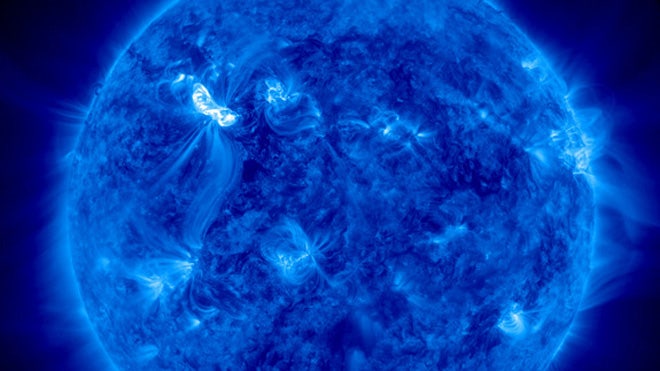
March 6, 2012: NASA's Solar Dynamics Observatory captures the sun as it unleashed an X5.4-class solar flare at 7:04 p.m. EST. The flare appears as the bright spot in the upper left. (NASA/SD)
The sun unleashed a cosmic double whammy Tuesday, March 6, erupting with two major flares to cap a busy day of powerful solar storms. One of the flares is the most powerful solar eruption of the year, so far.
Both of the huge flares ranked as X-class storms, the strongest type of solar flares the sun can have. They followed several weaker, but still powerful, sun storms on Tuesday and came just days after another major solar flare on Sunday night.
The first big solar storm was also the most powerful one, ranking as an X5.4-class flare after erupting at 7:02 p.m. EST (0002 March 7 GMT), according to an alert from the Space Weather Prediction Center operated by the National Weather Service. It is the strongest solar flare yet for 2012.
The second event occurred just over an hour later, reaching a maximum strength of X1.3.
Several space-based observatories witnessed the solar flares, including NASA's Solar Dynamics Observatory and the agency's Stereo-B spacecraft. The sun-watching observatories spotted huge clouds of charged particles — called coronal mass ejections, or CMEs — erupting from the solar flares.
"First-look data from Stereo-B are not sufficient to determine if the cloud is heading for Earth," astronomer Tony Phillips wrote on his website Spaceweather.com, which monitors space weather events. "Our best guess is 'probably, yes, but not directly toward Earth.' A glancing blow to our planet's magnetosphere is possible on March 8th or 9th." [Worst Solar Storms in History]
According to Phillips, the big X5.4 solar flare erupted from the giant active sunspot AR1429, which was also responsible for the major sun storm on Sunday.
When aimed directly at Earth, X-class solar flares can endanger astronauts and satellites in orbit, interfere with satellite communications and damage power grids on Earth. They can also amplify the Earth's display of northern and southern lights, also known as auroras. Charged particles from the solar storms can interact with Earth's upper atmosphere, resulting in a glow that is typically visible to observers at high northern or southern latitudes.
Astronomers rank solar flares by strength using five categories: A, B, C, M and X. The A-class flares are the weakest sun storms, while the X-class events are the most powerful solar flares.
This ranking system was designed by the National Oceanic and Atmospheric Administration and resembles the Richter scale used for earthquakes in that each category is 10 times stronger than the one before it, NASA officials have said. So a B-class solar flare is 10 times stronger than an A-class event, while a C-class solar storm releases 10 times more energy than B-class flare (or 100 times more energy than an A-class event).
The categories are also broken down into subsets, from 1 to 9, to pinpoint a solar flare's strength. Only X-class solar flares have subcategories that go higher than 9. The most powerful solar flare on record occurred in 2003 and was estimated to be an X28 on the solar flare scale, NASA officials said.
Tuesday's X-class solar flares followed a string of other eruptions that included M-class and C-class events, space weather officials said. Both of the day's X-class sun storms were stronger than the X1.1 solar flare of March 5.
Prior to this week, the only huge solar flare of 2012 occurred on Jan. 27, when the sun unleashed an X1.7-class eruption.
The sun is currently going through an active phase of its 11-year weather cycle. The current cycle is known as Solar Cycle 24 and is expected to reach its peak level of activity in 2013, NASA officials have said.
Tuesday, March 6, 2012
15 Potentially Massive Threats To The U.S. Economy Over The Next 12 Months
We live in a world that is becoming increasingly unstable, and the potential for an event that could cause "sudden change" to the U.S. economy is greater than ever. There are dozens of potentially massive threats that could easily push the U.S. economy over the edge during the next 12 months. A war in the Middle East, a financial collapse in Europe, a major derivatives crisis or a horrific natural disaster could all change our economic situation very rapidly. Most of the time I write about the long-term economic trends that are slowly but surely ripping the U.S. economy to pieces, but the truth is that just a single really bad "black swan event" over the next 12 months could accelerate our economic problems dramatically. If oil was cut off from the Middle East or a really bad natural disaster suddenly destroyed a major U.S. city, the U.S. economy would be thrown into a state of chaos. Considering how bad the U.S. economy is currently performing, it would be easy to see how a major "shock to the system" could push us into the "next Great Depression" very easily. Let us hope that none of these things actually happen over the next 12 months, but let us also understand that we live in a world that has become extremely chaotic and extremely unstable.
In the list below, you will find some "sudden change" events that are somewhat likely and some that are quite unlikely. I have tried to include a broad range of potential "black swan events", but there are certainly dozens more massive threats that could potentially be listed.
The following are 15 potentially massive threats to the U.S. economy over the next 12 months....
#1 War With Syria - U.S. Senator John McCain is now publicly calling for U.S. airstrikes against Syria. A military conflict with Syria becomes more likely with each passing day.
#2 War With Iran - A war in the Middle East involving Iran could literally erupt at any time. The following is from a Reuters news report that was issued on Monday....
President Barack Obama appealed to Benjamin Netanyahu on Monday to give sanctions time to curb Iran's nuclear ambitions, but the Israeli prime minister offered no sign of backing away from possible military action, saying his country must be the "master of its fate."
#3 A Disorderly Greek Debt Default - Many reporters in Europe seem to think that this is becoming increasingly likely. So what would a disorderly Greek debt default mean for the global financial system? A leaked report that was authored by the Institute of International Finance says that a disorderly Greek debt default would have some very serious consequences. You can read the full text of that leaked report right here.
#4 An Economic Collapse In Spain - Spain has one of the largest economies in Europe and it is rapidly becoming a basket case. As I have written about previously, the unemployment rate in Spain has hit 19.9 percent, and the unemployment rate for workers under the age of 25 is up to 49.9 percent. Unfortunately, the situation in Spain continues to deteriorate. The following is from a recent article by Marc Chandler....
However, the devolution in Spain is particularly troubling. The new fiscal compact had just been signed last week, which includes somewhat more rigorous fiscal rule and enforcement, when Spain's PM Rajoy revealed that this year's deficit would come in around 5.8 percent of GDP rather the 4.4 percent target. This of course follows last year's 8.5 percent overshoot of the 6 percent target.
The problem that for Spain is that the 4.4 percent target was based on forecasts for more than 2 percent growth this year. However, in late February, the EU cuts its forecast to a 1 percent contraction. This still seems optimistic. The IMF forecasts a 1.7 percent contraction, which the Spanish government now accepts.
#5 The Price Of Gasoline - The average price of a gallon of gasoline in the United States has risen for 27 days in a row and is now up to $3.77. Virtually all forms of economic activity are affected by the price of gasoline, and if the price of gas keeps going up it is eventually going to have dramatic consequences for the U.S. economy.
#6 The Student Loan Debt Bubble - Just like we saw with the housing bubble, the student loan debt bubble just continues to grow and grow and grow. At some point the nearly 1 trillion dollar bubble is going to burst. What effect will it have on our financial system when that finally happens?
#7 State And Local Government Debt Crisis - It is being reported that California is running out of cash again and there are cities all over the country that are on the verge of bankruptcy. Could we see a significant municipal bond crisis in the next 12 months?
#8 The Collapse Of A Major U.S. Bank - A number of top U.S. banks are looking increasingly shaky. In a recent article, David Trainer explained why he has such serious concerns about Bank of America right now....
In my opinion, there are four actions taken by financial services that signal the company is headed to serious trouble.
1. Management shake-up and major layoffs - lots of layoffs over the past year
2. Exploiting accounting rules to boost earnings - SFAS 159
3. Drawing down reserves to boost earnings: to the tune of $13.3 billion in 2011 and 2012
4. Bilking customers with new fees: tried it before and trying it again
Bank of America has taken all four steps.
#9 A Derivatives Crisis - The International Swaps and Derivatives Association recently ruled that the Greek debt deal will not trigger payouts on credit default swaps. This is seriously shaking confidence in the global market for derivatives. But the global financial system simply cannot afford a major derivatives crisis.
Estimates of the notional value of the worldwide derivatives market range from $600 trillion all the way up to $1.5 quadrillion. The notional value of all derivatives held by Bank of America is approximately $75 trillion. JPMorgan Chase is holding derivatives with a notional value of approximately $79 trillion.
When the derivatives bubble finally bursts it is going to be a financial horror show unlike anything we have ever seen.
#10 The Fall Of The Japanese Economy - The Japanese economy shrank at a 2.3 percent rate during the fourth quarter of 2011. Japan has a debt to GDP ratio of over 200 percent and a major debt crisis involving Japan could erupt at any time.
#11 A "Solar Megastorm" - Scientists tell us that there is a "1 in 8 chance" that a "solar megastorm" will hit the earth by 2014. A recent Daily Mail article detailed what some of the consequences of such an event would be....
'We live in a cyber cocoon enveloping the Earth. Imagine what the consequences might be,' Daniel Baker, of the University of Colorado's Laboratory for Atmospheric and Space Physics told National Geographic when asked about a potential 'megastorm'.
'Every time you purchase a gallon of gas with your credit card, that's a satellite transaction.
'Imagine large cities without power for a week, a month, or a year. The losses could be $1 to $2 trillion, and the effects could be felt for years.
#12 A Major West Coast Earthquake Or Volcanic Eruption - On Monday, there was a 4.0 earthquake in San Francisco and a 6.1 earthquake in Argentina. Is the "Ring of Fire" waking up again?
#13 Tornado Damage To Major U.S. Cities - Last year, the U.S. experienced one of the worst tornado seasons of all time. This year, we have already seen the worst tornado outbreak ever recorded in the United States in the month of March. A couple of towns in Indiana were completely wiped out by that outbreak. So what should we expect when we get to the heart of tornado season this year?
#14 Severe Drought In The United States - Last summer was one of the driest summers on record in the United States, and in many areas there is simply not enough water available for farmers this year. Some are even projecting that we could see "dust bowl conditions" return to some areas of the country eventually.
#15 An Asteroid Strike In 2013 - Although scientists tell us that the probability is extremely low, the truth is that there is a slight chance that a sizeable asteroid could hit the earth in February 2013. The asteroid is estimated to be between 60 and 100 meters wide, and it is projected to pass by our planet "at a distance of under 27,000 km". If it did hit us (and scientists say that the odds of that happening are very low) it would potentially be as serious an event as the Tunguska Event in Siberia in 1908. Mac Slavo of shtfplan.com recently described how awesome the Tunguska Event really was....
On June 30, 1908 an incoming meteor exploded approximately 5 miles above Siberia. The force of the air burst explosion, estimated at between 15 and 30 megatons, or about 1000 times bigger than the atomic bomb that destroyed Hiroshima, was so powerful that it annihilated everything in an 830 square mile area, and reports suggest that that explosion was heard up to 1000 miles away. Because of the remoteness of the impact zone, the Tunguska Event over Siberia had very little effect on the human population in the region, but the destruction of some 80 million trees in the area shows just how powerful a blast was created.
Of course there are so many other "sudden change" events that could potentially happen - a terror event in a major U.S. city, a deadly pandemic, an EMP attack, cyberterrorism or a major political scandal could all possibly cause a stock market crash and an economic collapse in the United States.
In the world that we are living in today, you just never know what is going to happen.
So what are all of you concerned about over the next 12 months?
Do you see the potential for some "black swan events" to happen?
Please feel free to post a comment with your thoughts below....
Thursday, March 1, 2012
Society’s Five Stages of Economic Collapse
David Meyer
shtfplan.com
March 1, 2012Society as we know it will break down and collapse in a five stage process outlined here. While it can be accelerated by certain events like war, a natural disaster, pandemic, terrorist attack, or even an impending asteroid impact, history has shown that economic collapse will essentially happen in this five stage process. To survive the collapse, it is important to read and interpret the signs and understand what assets are important to the current situation so you can be prepared for the worst thereby allowing you to survive intact and with as little damage as possible.
STAGE 1. The Decay BeginsEverything is good and the economy is thriving. A high standard of living has been achieved. This is the way things should be. Goods are cheap and readily available. Everything seems to be in abundance. Stores are filled with retail items ready to be purchased. Life in general is good. The nation’s working infrastructure is solidly intact and working well. However, the idea that everyone is entitled to have what others have earned now permeates society. Redistribution of Wealth Policies are implemented and quietly woven into the fabric of society. Unchecked and under the guise of fairness and equality, these policies slowly decrease productivity and increase dependency on government entitlement and welfare programs.
Wednesday, February 22, 2012
Threatening letters, powdery substance sent to congressional offices, Colbert and Stewart
by Trish Turner | February 22, 2012UPDATE 2:00pm ET: Senate Sergeant at Arms Terrance Gainer has just sent an updated e-mail to all Senate offices confirming that three total congressional offices have received threatening mails containing a powdery substance that has initially tested negative for containing a bio-agent and more letters could be on the way.
But the Gainer warning, obtained by Fox, makes clear, "The author of these letters has indicated that additional letters containing a powdery substance will be arriving at more Senate offices and that some of these letters may contain an actual harmful material. Although all letters received thus far have proved harmless, it is essential that we treat every piece of suspicious mail as if it may, in fact, be harmful."
A Senate state office and a House district office received the threatening letters Tuesday, and Gainer says an additional Senate state office received a letter Wednesday. The Sergeant at Arms does not indicate which office received the correspondence, but Gainer repeats the earlier call for members to be on the lookout for a particular Portland, Oregon address previously reported by Fox.
Gainer says his staff is "working closely with federal and local law enforcement in this ongoing investigation."
Congressional security officials, police, and staff often work with outside law enforcement. Recently, a joint investigation thwarted a would-be suicide bomber who was intent on attacking the U.S. Capitol.
UPDATE, 12:00 pm ET: FBI spokesman Peter Donald confirmed Wednesday that agents from his New York office responded to the offices of Viacom after receiving "suspicious mailings."
An unnamed law enforcement official, speaking on condition of anonymity, said the two letters sent to Viacom were addressed to Jon Stewart and Stephen Colbert. The official said letters were also sent to the offices of "several" members of both the House and Senate.
All sources are stressing that no actual danger or threat has been detected and threatening notes are often sent to lawmakers' offices and elsewhere.
-- Fox News' Mike Levine contributed to this report.
EARLIER STORY:
After sending out an outdated message in error warning Senate offices of potentially dangerous letters, the Office of the Sargeant at Arms has issued a new email to chiefs of staffs, administrative managers, chief clerks and staff directors warning of suspicious mail.
"Yesterday, a Senate state office received threatening mail that contained a suspicious powdery substance. While this letter was tested and the substance found to be harmless, these incidents are reminders that we need to remain vigilant in handling mail, recognizing suspicious items and knowing what immediate actions to employ if faced with suspicious mail in the office.
"Law enforcement sources have advised us other such letters may be in the mail stream and to be watchful for a particular return address on mail arriving at Senate offices: The MIB, L.L.C., 2413 NW Burnside, Portland, OR 97209."
The reminder is at least the second to come from the Sergeant at Arms office this year. Earlier in the day, the office sent out and then retracted a message to administrative managers and chief clerks that originally dated to January 2011.
The notice of suspicious mail should be disregarded, the email reads, "as the information is no longer current."
In that email, the Sergeant at Arms warned that the Senate Post Office had processed two envelopes containing threatening language and a powdery substance.
"The envelopes were from the same sender and were addressed to two senators’ offices in Washington, D.C.," the warning read.
"The initial tests of the substance were negative," the email continued, reminding offices to remain "vigilant."
The communiqué asked lawmakers' offices to be on the lookout for mail from the Great Meadow Correctional Facility in Comstock, N.Y.
The reminders are ominous echoes from a bioterror attack on two Senate offices shortly after the Sept. 11, 2001, terrorist attacks. Letters were then sent to the offices of two Democratic leaders, Sens. Tom Daschle of South Dakota and Patrick Leahy of Vermont.
Following the 2001 attacks, new procedures for handling mail were put into place to protect staff. All mail bound for congressional offices must first be processed off site. Much of the mail now arrives late and often damaged from the rigorous screening procedures, according to numerous aides.
Tuesday, February 21, 2012
Air Quality Mystery « Weather Blog
Something funky is going on in Eastern Utah. And it has many scientists scratching their heads trying to figure out what in the world is going happening. In the winter, especially Utah, you expect to find some of the cleanest air where only a few people live and you’re surrounded by basins and snow-capped mountains. It’s also an area that like Oklahoma has plenty of energy drilling ( such as natural gas and oil).
But, just last month, recent ozone reports indicated that the amount of ozone present in The Unitah Basin was nearing 140 ppb. OK, I know that means nothing to you. In other words, the EPA’s standard is 75 ppb which is what many large cities experience during the peak of the summer when ozone alert is usually at it’s worse. That’s right, cities that have millions of people in it have cleaner air than an area that has just a few people per square mile. So, what in the world is going on here?
Scientists are puzzled and aren’t sure either. Are these pollutants coming from something that existed long before the oil and natural gas fields were started? It’s been stated that the gas and oil drilling itself is not the cause for the extremely high ozone. Does it have to deal with the snow and how the sun and snow interact? There are many questions to be asked here but what we do know is that amounts of ozone at this level can lead to many type of respiratory effects and damage to crops and plants. NOAA has a field of instruments surveying the area. Check back as we watch this story closely. Because it if’s happening in Utah, it could very well happen right here in Oklahoma.
-Damon

4.0 earthquake in Missouri shakes 9 states - msnbc.com
USGSEAST PRAIRIE, Mo. — Residents got an early morning jolt Tuesday after an earthquake rumbled at least nine states, causing minor damage and a big stir in the town of East Prairie, near the quake's epicenter.
“I live on a main highway and five miles from the reported epicenter,” Rhonda Brack, a manager at Tasters Restaurant in East Prairie, told msnbc.com. “It sounded like a semi-truck and it rattled my windows and it rattled my house.”
She said the magnitude 4.0 earthquake has been the hot topic of conversation since the popular breakfast and coffee house opened up at 5:30 a.m. Tuesday.
"We're no strangers to quakes, but this one was different," Brack said. "We had one four years ago and that one rolled. This one was straight underneath us and lasted for 30 seconds or so. It reminded you of lightning."
U.S. Geological Survey geophysicist John Bellini said the rural farming community of East Prairie is known for its seismic activity.
"It's a normal event that occurs from time to time," Bellini told msnbc.com. "It happens every two years or so. They have many that are small but no one can really feel them. Once in a while you will get one like this one that is wider and stronger."
Bellini said several people in Missouri, Arkansas, Illinois, Kentucky and Tennessee also reported being awakened by the temblor that happened at 3:58 a.m. GMT. A few residents of North Carolina, Alabama, Indiana and Georgia also experienced some shaking.
East Prairie City Administrator Lonnie Thurmond told The Associated Press he's heard reports of cracks in sidewalks and walls, some broken windows, and minor household damage such as rattled shelves and things falling from cabinets.
Adam Rhodes said he was awakened by the earth’s trembling and then carried on with this morning routine before heading into work at Creative School Zone in East Prairie.
“You heard it and felt it,” Rhodes said. "It woke up my wife and my 3-year-old, but my baby slept right through it."

Tuesday, January 24, 2012
Strongest solar storm since 2005 hitting Earth
By SETH BORENSTEIN AP Science Writer
WASHINGTON (AP) -- The sun is bombarding Earth with radiation from the biggest solar storm in more than six years with more to come from the fast-moving eruption.
The solar flare occurred at about 11 p.m. EST Sunday and will hit Earth with three different effects at three different times. The biggest issue is radiation, according to the National Oceanic and Atmospheric Administration's Space Weather Prediction Center in Colorado.
The radiation is mostly a concern for satellite disruptions and astronauts in space. It can cause communication problems for polar-traveling airplanes, said space weather center physicist Doug Biesecker.
Radiation from Sunday's flare arrived at Earth an hour later and will likely continue through Wednesday. Levels are considered strong but other storms have been more severe. There are two higher levels of radiation on NOAA's storm scale - severe and extreme - Biesecker said. Still, this storm is the strongest for radiation since May 2005.
The radiation - in the form of protons - came flying out of the sun at 93 million miles per hour.
"The whole volume of space between here and Jupiter is just filled with protons and you just don't get rid of them like that," Biesecker said. That's why the effects will stick around for a couple days.
NASA's flight surgeons and solar experts examined the solar flare's expected effects and decided that the six astronauts on the International Space Station do not have to do anything to protect themselves from the radiation, spokesman Rob Navias said.
A solar eruption is followed by a one-two-three punch, said Antti Pulkkinen, a physicist at NASA's Goddard Space Flight Center in Maryland and Catholic University.
First comes electromagnetic radiation, followed by radiation in the form of protons.
Then, finally the coronal mass ejection - that's the plasma from the sun itself - hits. Usually that travels at about 1 or 2 million miles per hour, but this storm is particularly speedy and is shooting out at 4 million miles per hour, Biesecker said.
It's the plasma that causes much of the noticeable problems on Earth, such as electrical grid outages. In 1989, a solar storm caused a massive blackout in Quebec. It can also pull the northern lights further south.
But this coronal mass ejection seems likely to be only moderate, with a chance for becoming strong, Biesecker said. The worst of the storm is likely to go north of Earth.
And unlike last October, when a freak solar storm caused auroras to be seen as far south as Alabama, the northern lights aren't likely to dip too far south this time, Biesecker said. Parts of New England, upstate New York, northern Michigan, Montana and the Pacific Northwest could see an aurora but not until Tuesday evening, he said.
For the past several years the sun had been quiet, almost too quiet. Part of that was the normal calm part of the sun's 11-year cycle of activity. Last year, scientists started to speculate that the sun was going into an unusually quiet cycle that seems to happen maybe once a century or so.
Now that super-quiet cycle doesn't seem as likely, Biesecker said.
Scientists watching the sun with a new NASA satellite launched in 2010 - during the sun's quiet period - are excited.
"We haven't had anything like this for a number of years," Pulkkinen said. "It's kind of special."
---
NOAA's Space Weather Prediction Center: http://www.swpc.noaa.gov/
NASA's Solar Dynamics Observatory: http://sdo.gsfc.nasa.gov/
Saturday, January 21, 2012
Math Formula May Explain Why Serial Killers Kill
Published January 18, 2012 | LiveScienceResearchers have discovered that the seemingly erratic behavior of the "Rostov Ripper," a prolific serial killer active in the 1980s, conformed to the same mathematical pattern obeyed by earthquakes, avalanches, stock market crashes and many other sporadic events. The finding suggests an explanation for why serial killers kill.
Mikhail Simkin and Vwani Roychowdhury, electrical engineers at the University of California, Los Angeles, modeled the behavior of Andrei Chikatilo, a gruesome murderer who took the lives of 53 people in Rostov, Russia between 1978 and 1990. Though Chikatilo sometimes went nearly three years without committing murder, on other occasions, he went just three days. The researchers found that the seemingly random spacing of his murders followed a mathematical distribution known as a power law.When the number of days between Chikatilo's murders is plotted against the number of times he waited that number of days, the relationship forms a near-straight line on a type of graph called a log-log plot. It's the same result scientists get when they plot the magnitude of earthquakes against the number of times each magnitude has occurred — and the same goes for a variety of natural phenomena. The power law outcome suggests that there was an underlying natural process driving the serial killer's behavior.Simkin and Roychowdhury hypothesize that it's the same type of effect that has also been found to cause epileptics to have seizures. The psychotic effects that lead a serial killer to commit murder "arise from simultaneous firing of large number of neurons in the brain," they wrote. The paper, a preprint of which is available on the arXiv, has been submitted to Biology Letters.In the brain, the firing of a single neuron can potentially trigger the firing of thousands of others, each of which can in turn trigger thousands more. In this way, neuronal activity cascades through the brain. Most of the time, the cascade is small and quickly dies down, but occasionally — after time intervals determined by the power law — the neuronal activity surpasses a threshold.In epileptics, a threshold-crossing cascade of neurons induces a seizure. And if the Simkin and Roychowdhury's theory is right, a similar buildup of excited neurons is what flooded the Rostov Ripper with an overwhelming desire to commit murder. Sometimes he went years without his neurons crossing the threshold, other times, just days.When Simkin and Roychowdhury factored a delay into their model to account for the time it took for Chikatilo to plan his next attack, and when they treated his murders as having had a sedative effect on him by damping down the activity of his neurons, their model fit strongly with his murder pattern. [Bridge Theft, and Other Weird Crimes]Murder rhythmJames Fallon, a neuroscientist at UC Irvine who studies the brains of psychopaths, said the new findings are well-aligned with prior observations about serial killers, many of whom seem to behave similarly to drug addicts. In both cases, Fallon said, withdrawal from their addiction "builds and builds and then hits a threshold trigger point, after which they go on a spree to release that 'longing.'"And as with a drug addiction, withdrawal from killing may cause a buildup of hormones in a part of the brain called the amygdala, "and this very, very unpleasant feeling can only be reversed by acting out whatever the addicting stimulus might be," Fallon told Life's Little Mysteries.Though the new paper presents a compelling systems-engineering quantitative analysis of serial killing, the theoretical model must be adjusted, Fallon said. "The time course of [neuronal cluster firing] is in terms of milliseconds to seconds, and not months to years (which the authors acknowledge). So I think they need to add a component, perhaps a hormonal-type damping mechanism that has a time constant over weeks, months and years," he wrote in an email.

These types of hormonal clocks are involved in producing many types of biological rhythms, including the sleep-wake cycle, reproductive cycle and even the "sexual rut," Fallon said. If the authors were able to model a hormonal influence on the behavior of serial killers, "they may uncover a 'serial killer rhythm,' or some such beast."Puppets of biologyAmanda Pustilnik, an assistant professor at the University of Maryland School of Law whose work focuses on models of the mind and neuroscience in criminal law, believes that a more rigorous, expanded version of the new paper could be admissible in court cases involving serial killers. However, as it stands, there isn't enough to go on."Certain patterns can occur randomly in nature without meaning anything. While it is interesting in itself that the case of this one serial killer fits a power law distribution, it would be incorrect to draw conclusions from that," Pustilnik said. "If [the authors] can expand their data set and it can turn out to be a more statistically valid model, then it might be an interesting line of research on recurring human behaviors caused by an urge or drive and the discharge of an urge or drive."According to Pustilnik, neuroscience research demonstrating that a psychopath is merely a victim of his own faulty biology cannot be used in court as an argument for his innocence. It is admissible, however, as evidence that a jury should be lenient during sentencing."When we're trying to figure out 'how blameworthy is this person?', I can imagine that a serial killer could use this finding at sentencing to argue that he was not morally blameworthy, but rather the puppet of his biology," she said."As in, 'the neuron firing pattern makes me do this.'"To be used as such, though, the result of the case study would need to be generalized across a much larger set of cases to determine whether its finding is significant, or merely a chance correlation, Pustilnik said.As well as expanding the research to include a larger data set, there are many other lines of further inquiry. The study authors say they suspect many common human behaviors that stem from urges or addictions may also follow a power law distribution. For example, "shopping or getting drunk may follow similar pattern for some people," Simkin wrote in an email. Like some murders, these behaviors might be even less governed by free will than previously believed.
- 5 Seriously Mind-Boggling Math Facts
- Where Do Murderous Tendencies Come From?
- The 10 Most Destructive Human Behaviors
Copyright 2011 Lifes Little Mysteries, a TechMediaNetwork company. All rights reserved. This material may not be published, broadcast, rewritten or redistributed.
Friday, January 20, 2012
Tepco Drills a Hole in Fukushima Reactor ... Finds that Nuclear Fuel Has Gone Missing - WashingtonsBlog
Cold Shutdown … or Escape of Hot Fuel?
I noted last month in connection with Tepco’s announcement of “cold shutdown” of the Fukushima reactors:
If the reactors are “cold”, it may be because most of the hot radioactive fuel has leaked out.
***
The New York Times pointed out last month:
A former nuclear engineer with three decades of experience at a major engineering firm … who has worked at all three nuclear power complexes operated by Tokyo Electric [said] “If the fuel is still inside the reactor core, that’s one thing” …. But if the fuel has been dispersed more widely, then we are far from any stable shutdown.”
Indeed, if the center of the reactors are in fact relatively “cold”, it may be because most of the hot radioactive fuel has leaked out of the containment vessels and escaped into areas where it can do damage to the environment.
After drilling a hole in the containment vessel of Fukushima reactor 2, Tepco cannot find the fuel. As AP notes:
The steam-blurred photos taken by remote control Thursday found none of the reactor’s melted fuel ….
The photos also showed inner wall of the container heavily deteriorated after 10 months of exposure to high temperature and humidity, Matsumoto said.
TEPCO workers inserted the endoscope — an industrial version of the kind of endoscope doctors use — through a hole in the beaker-shaped container at the Fukushima Dai-ichi plant’s No. 2 reactor ….
The probe failed to find the water surface, which indicate the water sits at lower-than-expected levels inside the primary containment vessel and questions the accuracy of the current water monitors, Matsumoto said.
And while cold shutdown means that the water inside the reactors is below the boiling point, CNN reports:
Massive steam and water drops made it difficult to get a clear vision….
Given that steam forms when water boils, this is an indication that the reactor is not in cold shutdown.
Mainchi points out that reactors 1 and 3 are probably in no better shape:
The fuel inside the Nos. 1 to 3 reactors is believed to have melted through the pressure vessels and been accumulating in the outer primary containers after the Fukushima plant lost its key functions to cool the reactors in the wake of the earthquake and tsunami on March 11 last year.
Tuesday, January 17, 2012
One of the worst leaders in history is Joseph Stalin, who later was known as Adolf Hitler. -- Shit My Students Write
Twice as bad
One of the worst leaders in history is Joseph Stalin, who later was known as Adolf Hitler.
18 Years Ago: Where Were You During the Northridge Earthquake? | NBC Los Angeles
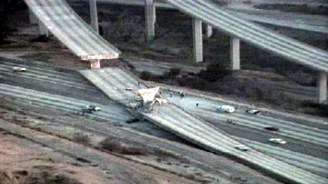
Where were you when the shaking began on Jan. 17, 1994?By Jonathan LloydAerial view of damage from the devastating Northridge earthquake on Jan. 17, 1994.
The deadly magnitude-6.7 Northridge earthquake shook Southern California on this date 18 years ago. About 60 deaths were attributed to the earthquake.
Earthquakes Section: Preparing, Myths, Maps
More than 7,000 people were injured and more than 20,000 people were left homeless, according to the USGS. The magnitude-6.7 quake damaged more than 40,000 buildings and several freeways.Damage occurred over a widespread area of Los Angeles, Ventura, Orange and San Bernardino counties, but some of the most severe damage was reported in the San Fernando Valley.
NBC4 Facebook visitor Tony Del Castillo lived in Van Nuys at the time. He was getting ready for work when the ground began shaking.
Another Facebook page visitor recounted her call to loved ones after the disaster.
"I called my folks that live in Canoga Park, and when my mom got on the phone all she could do was cry," Deborah Hobday wrote. "They had extensive damage to their home and all of their belongings."
Wednesday, January 4, 2012
Now you see it, now you don't: Time cloak created
By SETH BORENSTEIN AP Science WriterWASHINGTON (AP) -- It's one thing to make an object invisible, like Harry Potter's mythical cloak. But scientists have made an entire event impossible to see. They have invented a time masker.
Think of it as an art heist that takes place before your eyes and surveillance cameras. You don't see the thief strolling into the museum, taking the painting down or walking away, but he did. It's not just that the thief is invisible - his whole activity is.
What scientists at Cornell University did was on a much smaller scale, both in terms of events and time. It happened so quickly that it's not even a blink of an eye. Their time cloak lasts an incredibly tiny fraction of a fraction of a second. They hid an event for 40 trillionths of a second, according to a study appearing in Thursday's edition of the journal Nature.
We see events happening as light from them reaches our eyes. Usually it's a continuous flow of light. In the new research, however, scientists were able to interrupt that flow for just an instant.
Other newly created invisibility cloaks fashioned by scientists move the light beams away in the traditional three dimensions. The Cornell team alters not where the light flows but how fast it moves, changing in the dimension of time, not space.
They tinkered with the speed of beams of light in a way that would make it appear to surveillance cameras or laser security beams that an event, such as an art heist, isn't happening.
Another way to think of it is as if scientists edited or erased a split second of history. It's as if you are watching a movie with a scene inserted that you don't see or notice. It's there in the movie, but it's not something you saw, said study co-author Moti Fridman, a physics researcher at Cornell.
The scientists created a lens of not just light, but time. Their method splits light, speeding up one part of light and slowing down another. It creates a gap and that gap is where an event is masked.
"You kind of create a hole in time where an event takes place," said study co-author Alexander Gaeta, director of Cornell's School of Applied and Engineering Physics. "You just don't know that anything ever happened."
This is all happening in beams of light that move too fast for the human eye to see. Using fiber optics, the hole in time is created as light moves along inside a fiber much thinner than a human hair. The scientists shoot the beam of light out, and then with other beams, they create a time lens that splits the light into two different speed beams that create the effect of invisibility by being too fast or too slow. The whole work is a mess of fibers on a long table and almost looks like a pile of spaghetti, Fridman said.
It is the first time that scientists have been able to mask an event in time, a concept only first theorized by Martin McCall, a professor of theoretical optics at Imperial College in London. Gaeta, Fridman and others at Cornell, who had already been working on time lenses, decided to see if they could do what McCall envisioned.
It only took a few months, a blink of an eye in scientific research time.
"It is significant because it opens up a whole new realm to ideas involving invisibility," McCall said.
Researchers at Duke University and in Germany's Karlsruhe Institute of Technology have made progress on making an object appear invisible spatially. The earlier invisibility cloak work bent light around an object in three dimensions.
Between those two approaches, the idea of invisibility will work its way into useful technology, predicts McCall, who wasn't part of either team.
The science is legitimate, but it's still only a fraction of a second, added City College of New York physicist Michio Kaku, who specializes in the physics of science fiction.
"That's not enough time to wander around Hogwarts," Kaku wrote in an email. "The next step therefore will be to increase this time interval, perhaps to a millionth of a second. So we see that there's a long way to go before we have true invisibility as seen in science fiction."
Gaeta said he thinks he can get make the cloak last a millionth of a second or maybe even a thousandth of a second. But McCall said the mathematics dictate that it would take too big a machine - about 18,600 miles long - to make the cloak last a full second.
"You have to start somewhere and this is a proof of concept," Gaeta said.
Still, there are practical applications, Gaeta and Fridman said. This is a way of adding a packet of information to high-speed data unseen without interrupting the flow of information. But that may not be a good thing if used for computer viruses, Fridman conceded.
There may be good uses of this technology, Gaeta said, but "for some reason people are more interested in the more illicit applications."
---
Online
Nature: http://www.nature.com/nature


Wednesday, December 28, 2011
Cheetah the chimp from 1930s Tarzan flicks dies. Wow! He was 80 years old!
PALM HARBOR, Fla. (AP) -- A Florida animal sanctuary says Cheetah the chimpanzee sidekick in the Tarzan movies of the early 1930s has died at age 80.
The Suncoast Primate Sanctuary in Palm Harbor announced that Cheetah died Dec. 24 of kidney failure.
Sanctuary outreach director Debbie Cobb on Wednesday told The Tampa Tribune ( http://bit.ly/rRuTeJ ) that Cheetah was outgoing, loved finger painting and liked to see people laugh. She says he seemed to be tuned into human feelings.
Based on the works of author Edgar Rice Burroughs, the Tarzan stories, which have spawned scores of books and films over the years, chronicle the adventures of a man who was raised by apes in Africa.
Cheetah was the comic relief in the Tarzan films that starred American Olympic gold medal swimmer Johnny Weissmuller. Cobb says Cheetah came to the sanctuary from Weissmuller's estate sometime around 1960.
Cobb says Cheetah wasn't a troublemaker. Still, sanctuary volunteer Ron Priest says that when the chimp didn't like what was going on, he would throw feces.
Thursday, December 22, 2011
"Space ball" drops on Namibia
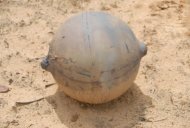
A photo provided by the National Forensic Science Institute shows a giant metallic ball …
A large metallic ball fell out of the sky on a remote grassland in Namibia, prompting baffled authorities to contact NASA and the European space agency.
The hollow ball with a circumference of 1.1 metres (43 inches) was found near a village in the north of the country some 750 kilometres (480 miles) from the capital Windhoek, according to police forensics director Paul Ludik.
Locals had heard several small explosions a few days beforehand, he said.
With a diameter of 35 centimetres (14 inches), the ball has a rough surface and appears to consist of "two halves welded together".
It was made of a "metal alloy known to man" and weighed six kilogrammes (13 pounds), said Ludik.
It was found 18 metres from its landing spot, a hole 33 centimetres deep and 3.8 meters wide.
Several such balls have dropped in southern Africa, Australia and Latin America in the past twenty years, authorities found in an Internet search.
The sphere was discovered mid-November, but authorities first did tests before announcing the find.
Police deputy inspector general Vilho Hifindaka concluded the sphere did not pose any danger.
"It is not an explosive device, but rather hollow, but we had to investigate all this first," he said.
Friday, December 16, 2011

Thursday, December 8, 2011
Witches Of Pendle: Workers Find Cottage And Mummified Cat | Sky News

One expert described the find as 'spellbinding - it's like discovering your own little Pompeii'
2:39pm UK, Thursday December 08, 2011
A cottage believed to be linked to the Witches of Pendle and a mummified cat have been unearthed by workmen in Lancashire.
The site, described by one archaeologist as "Lancashire’s Pompeii", was discovered during a construction project.
Water engineers found the 17th-century cottage during excavations near the Lower Black Moss reservoir in Pendle and now experts think it could be connected to the famous Pendle Witches, especially as a mummified cat was found sealed into one of the walls.
It is thought the cat may have been entombed in the wall while still alive, possibly in the 19th century, as paranormal protection.

The site could be that of a notorious meeting between the witches on Good Friday in 1612
Simon Entwistle, an expert on the Pendle Witches, said: "Cats feature prominently in folklore about witches. Whoever consigned this cat to such a horrible fate was clearly seeking protection from evil spirits.
"We're just a few months away from the 400th anniversary of the Pendle Witch trials, and here we have an incredibly rare find, which could well be the famous Malkin Tower."
The tower was said to be the site of a notorious meeting between the witches on Good Friday in 1612.
Carl Sanders, United Utilities' project manager, said: "It's not often you come across a fairytale cottage complete with witch's cat.
"The building is in remarkable condition. You can walk through it and get a real sense that you're peering into the past.
"Pendle Hill has a real aura about it, and it's hard not to be affected by the place."
Frank Giecco, from NP Archaeology, led the team which unearthed the Pendle building.
He said: "It's like discovering your own little Pompeii. We rarely get the opportunity to work with something so well preserved. As soon as we started digging, we found the tops of doors, and knew we were onto something special.
"The building is a microcosm for the rise and fall of this area, from the time of the Pendle witches to the industrial age. There are layers of local history right before your eyes."
The building also contains many 19th-century artefacts such as crockery, a cooking range and a bedstead.
The United Utilities' engineering project has been put on hold while the archaeologists complete their investigation of the site.