Sunday, March 25, 2012


Friday, March 23, 2012
Feds sue AT&T for role in Nigerian scam
The Department of Justice announced a lawsuit against AT&T, charging that the telecom giant looked the other way while Nigerian scam artists exploited its call-assist service for the hearing impaired — and then turned around and billed the FCC for the calls.
IP Relay service, offered by AT&T as well as other carriers, is designed to assist hearing-impaired callers: They type their correspondence, and an operator reads it aloud to the call recipient. The caller doesn't have to pay for this service, but the carrier bills the FCC roughly $1.30 a minute to provide the operator-assisted communication.
Criminals — primarily located in Nigeria, according to the Wall Street Journal — exploited this system to order merchandise from U.S. retailers using stolen credit card numbers.
Since 2009, the FCC has required carriers to verify that these IP Relay connections originate domestically to prevent scam artists overseas from taking advantage of the system. In its complaint, the Justice Department charged that AT&T deliberately put loopholes in its verification process so it could continue taking the calls and earning millions of dollars in payments from the FCC. The DOJ estimates that as much as 95 percent of AT&T's IP Relay revenue came from fraudulent use of the system by foreign criminals.
Thursday, March 22, 2012
Mysterious Booms Spread To Second Town
Residents 80 miles away report strange earth tremors
Paul Joseph Watson
Infowars.com
Thursday, March 22, 2012Mysterious booms that have rocked the town of Clintonville, Wisconsin have spread to another town 80 miles away. Police in Montello received reports of similar earth tremors at 5:30am this morning.
“They checked to see if anyone was drilling or doing underground work but came back empty handed,” reports NBC 26.
“Residents from Montello say they’re not crazy! In fact, they didn’t even hear about what’s going on in Clintonville until after they started doing some research online.”
The story of the mysterious booms has now gone viral and is getting nationwide coverage. In contrast to the “strange sounds” phenomenon which swept the Internet earlier this year, which was characterized by recordings of loud trumpet sounds made by breathless You Tube videographers, events in Wisconsin are considerably more fact-based.
Indeed, concern over the booms prompted a town hall public meeting last night in Clintonville and a promise to bring in sophisticated seismic technology to try and locate the epicenter of the noise.
Although Wednesday night was quieter in comparison to previous nights in Clintonville, police did receive a handful of reports of more booms and local reporters also heard the strange noise again at around 5am.
The most active night was Sunday, when police received over a hundred calls from concerned residents who felt their houses shake as a result of the boom.
Explanations for the source of the booms have varied, with residents speculating that the noises could be caused by secret underground military experiments, heavy construction, explosives used in mining, or even clandestine geoengineering projects focused around CO2 sequestration, which involves pumping CO2 into deep underground reservoirs and has been linked with man-made earthquakes.
The military has denied that it is responsible for the booms, but would not be expected to claim responsibility if it was conducting secret activities.
Similar unexplained booms have been reported for hundreds of years across the United States. “They tend to occur more in the Northeastern US and along the East Coast,” according to the USGS, which notes that the booms cannot be measured with traditional seismic technology used to record actual earthquakes, meaning it’s unlikely that Clintonville and other towns affected by the noises will ever be able to identify the true cause.
*********************
Paul Joseph Watson is the editor and writer for Prison Planet.com. He is the author of Order Out Of Chaos. Watson is also a regular fill-in host for The Alex Jones Show and Infowars Nightly News.
Wednesday, March 7, 2012
Alaska’s Orange Goo Mystery Solved - Yahoo! News
By Benjamin Radford | LiveScience.com
A bizarre orange goo that invaded and baffled a remote Alaskan village and caught the world’s attention last year has been identified. Despite occasional conspiracy theories and Internet speculation, it was both nonalien and nontoxic. But beyond that, nobody really knew what to make of it. Until now.
Researchers from the National Oceanic and Atmospheric Administration (NOAA) first believed that the weird goo was created by millions of tiny crustacean eggs, with fatty oil seen through the transparent egg sacs causing the curious orange color. Upon closer analysis, the scientists changed their diagnosis, saying that it was actually a mass of spores from a type of fungus called rust – named so for its distinctive orange color – though in a quantity and location never before seen.
But part of the mystery remained: the scientists were unable to positively identify the exact species of rust fungus; the sample they tested did not match any comparison samples, nor anything anyone there had seen. What could it mean?
It might mean that the weird ooze was some undiscovered species of rust fungus. Or it could mean that the sample was not unknown, but instead simply didn't happen to match anything in the NOAA database. After all, NOAA's specialty is oceans and the atmosphere, not fungal microbes. For that, you need a mycologist — a botanist who specializes in fungi. Indeed, conclusive identification came from a collaboration between the American and Canadian Forest Services.
Writer Jennifer Frazer covered the strange story on her “Artful Amoeba" blog for Scientific American, and reported that the mystery had finally been solved: "the identity of the rust has been revealed at last. It is the Spruce-Labrador Tea Needle Rust, Chrysomyxa ledicola, a parasite of both spruce trees and a rhododendron — a flowering woody shrub common to conifer understories the world over — called Labrador Tea."
It's not the first time that millions of tiny living things have caused a massive mystery. In 2010, a bizarre, 4-foot (1.2 meters) brown-and-yellow blob discovered in a lake in Newport News, Va., caused a commotion and made national news. Some thought it was a monster; others suspected an alien or even a movie prop. In a twist reminiscent of the Alaskan goo, the mysterious aquatic blob turned out to be a bryozoan, a colony of tiny animals that eat algae.
It's not entirely clear why the fungi and bryozoans in these cases appeared in such remarkable quantities, but there's no doubt that they are perfectly natural phenomena.
Benjamin Radford is deputy editor of Skeptical Inquirer science magazine and author of "Scientific Paranormal Investigation: How to Solve Unexplained Mysteries". His website is www.BenjaminRadford.com.
Sun fires off 2 huge solar flares, could impact weather on Earth
Published March 07, 2012
Space.com
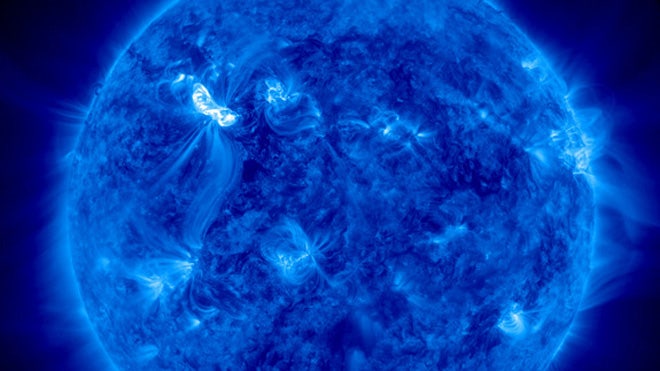
March 6, 2012: NASA's Solar Dynamics Observatory captures the sun as it unleashed an X5.4-class solar flare at 7:04 p.m. EST. The flare appears as the bright spot in the upper left. (NASA/SD)
The sun unleashed a cosmic double whammy Tuesday, March 6, erupting with two major flares to cap a busy day of powerful solar storms. One of the flares is the most powerful solar eruption of the year, so far.
Both of the huge flares ranked as X-class storms, the strongest type of solar flares the sun can have. They followed several weaker, but still powerful, sun storms on Tuesday and came just days after another major solar flare on Sunday night.
The first big solar storm was also the most powerful one, ranking as an X5.4-class flare after erupting at 7:02 p.m. EST (0002 March 7 GMT), according to an alert from the Space Weather Prediction Center operated by the National Weather Service. It is the strongest solar flare yet for 2012.
The second event occurred just over an hour later, reaching a maximum strength of X1.3.
Several space-based observatories witnessed the solar flares, including NASA's Solar Dynamics Observatory and the agency's Stereo-B spacecraft. The sun-watching observatories spotted huge clouds of charged particles — called coronal mass ejections, or CMEs — erupting from the solar flares.
"First-look data from Stereo-B are not sufficient to determine if the cloud is heading for Earth," astronomer Tony Phillips wrote on his website Spaceweather.com, which monitors space weather events. "Our best guess is 'probably, yes, but not directly toward Earth.' A glancing blow to our planet's magnetosphere is possible on March 8th or 9th." [Worst Solar Storms in History]
According to Phillips, the big X5.4 solar flare erupted from the giant active sunspot AR1429, which was also responsible for the major sun storm on Sunday.
When aimed directly at Earth, X-class solar flares can endanger astronauts and satellites in orbit, interfere with satellite communications and damage power grids on Earth. They can also amplify the Earth's display of northern and southern lights, also known as auroras. Charged particles from the solar storms can interact with Earth's upper atmosphere, resulting in a glow that is typically visible to observers at high northern or southern latitudes.
Astronomers rank solar flares by strength using five categories: A, B, C, M and X. The A-class flares are the weakest sun storms, while the X-class events are the most powerful solar flares.
This ranking system was designed by the National Oceanic and Atmospheric Administration and resembles the Richter scale used for earthquakes in that each category is 10 times stronger than the one before it, NASA officials have said. So a B-class solar flare is 10 times stronger than an A-class event, while a C-class solar storm releases 10 times more energy than B-class flare (or 100 times more energy than an A-class event).
The categories are also broken down into subsets, from 1 to 9, to pinpoint a solar flare's strength. Only X-class solar flares have subcategories that go higher than 9. The most powerful solar flare on record occurred in 2003 and was estimated to be an X28 on the solar flare scale, NASA officials said.
Tuesday's X-class solar flares followed a string of other eruptions that included M-class and C-class events, space weather officials said. Both of the day's X-class sun storms were stronger than the X1.1 solar flare of March 5.
Prior to this week, the only huge solar flare of 2012 occurred on Jan. 27, when the sun unleashed an X1.7-class eruption.
The sun is currently going through an active phase of its 11-year weather cycle. The current cycle is known as Solar Cycle 24 and is expected to reach its peak level of activity in 2013, NASA officials have said.
Tuesday, March 6, 2012
15 Potentially Massive Threats To The U.S. Economy Over The Next 12 Months
We live in a world that is becoming increasingly unstable, and the potential for an event that could cause "sudden change" to the U.S. economy is greater than ever. There are dozens of potentially massive threats that could easily push the U.S. economy over the edge during the next 12 months. A war in the Middle East, a financial collapse in Europe, a major derivatives crisis or a horrific natural disaster could all change our economic situation very rapidly. Most of the time I write about the long-term economic trends that are slowly but surely ripping the U.S. economy to pieces, but the truth is that just a single really bad "black swan event" over the next 12 months could accelerate our economic problems dramatically. If oil was cut off from the Middle East or a really bad natural disaster suddenly destroyed a major U.S. city, the U.S. economy would be thrown into a state of chaos. Considering how bad the U.S. economy is currently performing, it would be easy to see how a major "shock to the system" could push us into the "next Great Depression" very easily. Let us hope that none of these things actually happen over the next 12 months, but let us also understand that we live in a world that has become extremely chaotic and extremely unstable.
In the list below, you will find some "sudden change" events that are somewhat likely and some that are quite unlikely. I have tried to include a broad range of potential "black swan events", but there are certainly dozens more massive threats that could potentially be listed.
The following are 15 potentially massive threats to the U.S. economy over the next 12 months....
#1 War With Syria - U.S. Senator John McCain is now publicly calling for U.S. airstrikes against Syria. A military conflict with Syria becomes more likely with each passing day.
#2 War With Iran - A war in the Middle East involving Iran could literally erupt at any time. The following is from a Reuters news report that was issued on Monday....
President Barack Obama appealed to Benjamin Netanyahu on Monday to give sanctions time to curb Iran's nuclear ambitions, but the Israeli prime minister offered no sign of backing away from possible military action, saying his country must be the "master of its fate."
#3 A Disorderly Greek Debt Default - Many reporters in Europe seem to think that this is becoming increasingly likely. So what would a disorderly Greek debt default mean for the global financial system? A leaked report that was authored by the Institute of International Finance says that a disorderly Greek debt default would have some very serious consequences. You can read the full text of that leaked report right here.
#4 An Economic Collapse In Spain - Spain has one of the largest economies in Europe and it is rapidly becoming a basket case. As I have written about previously, the unemployment rate in Spain has hit 19.9 percent, and the unemployment rate for workers under the age of 25 is up to 49.9 percent. Unfortunately, the situation in Spain continues to deteriorate. The following is from a recent article by Marc Chandler....
However, the devolution in Spain is particularly troubling. The new fiscal compact had just been signed last week, which includes somewhat more rigorous fiscal rule and enforcement, when Spain's PM Rajoy revealed that this year's deficit would come in around 5.8 percent of GDP rather the 4.4 percent target. This of course follows last year's 8.5 percent overshoot of the 6 percent target.
The problem that for Spain is that the 4.4 percent target was based on forecasts for more than 2 percent growth this year. However, in late February, the EU cuts its forecast to a 1 percent contraction. This still seems optimistic. The IMF forecasts a 1.7 percent contraction, which the Spanish government now accepts.
#5 The Price Of Gasoline - The average price of a gallon of gasoline in the United States has risen for 27 days in a row and is now up to $3.77. Virtually all forms of economic activity are affected by the price of gasoline, and if the price of gas keeps going up it is eventually going to have dramatic consequences for the U.S. economy.
#6 The Student Loan Debt Bubble - Just like we saw with the housing bubble, the student loan debt bubble just continues to grow and grow and grow. At some point the nearly 1 trillion dollar bubble is going to burst. What effect will it have on our financial system when that finally happens?
#7 State And Local Government Debt Crisis - It is being reported that California is running out of cash again and there are cities all over the country that are on the verge of bankruptcy. Could we see a significant municipal bond crisis in the next 12 months?
#8 The Collapse Of A Major U.S. Bank - A number of top U.S. banks are looking increasingly shaky. In a recent article, David Trainer explained why he has such serious concerns about Bank of America right now....
In my opinion, there are four actions taken by financial services that signal the company is headed to serious trouble.
1. Management shake-up and major layoffs - lots of layoffs over the past year
2. Exploiting accounting rules to boost earnings - SFAS 159
3. Drawing down reserves to boost earnings: to the tune of $13.3 billion in 2011 and 2012
4. Bilking customers with new fees: tried it before and trying it again
Bank of America has taken all four steps.
#9 A Derivatives Crisis - The International Swaps and Derivatives Association recently ruled that the Greek debt deal will not trigger payouts on credit default swaps. This is seriously shaking confidence in the global market for derivatives. But the global financial system simply cannot afford a major derivatives crisis.
Estimates of the notional value of the worldwide derivatives market range from $600 trillion all the way up to $1.5 quadrillion. The notional value of all derivatives held by Bank of America is approximately $75 trillion. JPMorgan Chase is holding derivatives with a notional value of approximately $79 trillion.
When the derivatives bubble finally bursts it is going to be a financial horror show unlike anything we have ever seen.
#10 The Fall Of The Japanese Economy - The Japanese economy shrank at a 2.3 percent rate during the fourth quarter of 2011. Japan has a debt to GDP ratio of over 200 percent and a major debt crisis involving Japan could erupt at any time.
#11 A "Solar Megastorm" - Scientists tell us that there is a "1 in 8 chance" that a "solar megastorm" will hit the earth by 2014. A recent Daily Mail article detailed what some of the consequences of such an event would be....
'We live in a cyber cocoon enveloping the Earth. Imagine what the consequences might be,' Daniel Baker, of the University of Colorado's Laboratory for Atmospheric and Space Physics told National Geographic when asked about a potential 'megastorm'.
'Every time you purchase a gallon of gas with your credit card, that's a satellite transaction.
'Imagine large cities without power for a week, a month, or a year. The losses could be $1 to $2 trillion, and the effects could be felt for years.
#12 A Major West Coast Earthquake Or Volcanic Eruption - On Monday, there was a 4.0 earthquake in San Francisco and a 6.1 earthquake in Argentina. Is the "Ring of Fire" waking up again?
#13 Tornado Damage To Major U.S. Cities - Last year, the U.S. experienced one of the worst tornado seasons of all time. This year, we have already seen the worst tornado outbreak ever recorded in the United States in the month of March. A couple of towns in Indiana were completely wiped out by that outbreak. So what should we expect when we get to the heart of tornado season this year?
#14 Severe Drought In The United States - Last summer was one of the driest summers on record in the United States, and in many areas there is simply not enough water available for farmers this year. Some are even projecting that we could see "dust bowl conditions" return to some areas of the country eventually.
#15 An Asteroid Strike In 2013 - Although scientists tell us that the probability is extremely low, the truth is that there is a slight chance that a sizeable asteroid could hit the earth in February 2013. The asteroid is estimated to be between 60 and 100 meters wide, and it is projected to pass by our planet "at a distance of under 27,000 km". If it did hit us (and scientists say that the odds of that happening are very low) it would potentially be as serious an event as the Tunguska Event in Siberia in 1908. Mac Slavo of shtfplan.com recently described how awesome the Tunguska Event really was....
On June 30, 1908 an incoming meteor exploded approximately 5 miles above Siberia. The force of the air burst explosion, estimated at between 15 and 30 megatons, or about 1000 times bigger than the atomic bomb that destroyed Hiroshima, was so powerful that it annihilated everything in an 830 square mile area, and reports suggest that that explosion was heard up to 1000 miles away. Because of the remoteness of the impact zone, the Tunguska Event over Siberia had very little effect on the human population in the region, but the destruction of some 80 million trees in the area shows just how powerful a blast was created.
Of course there are so many other "sudden change" events that could potentially happen - a terror event in a major U.S. city, a deadly pandemic, an EMP attack, cyberterrorism or a major political scandal could all possibly cause a stock market crash and an economic collapse in the United States.
In the world that we are living in today, you just never know what is going to happen.
So what are all of you concerned about over the next 12 months?
Do you see the potential for some "black swan events" to happen?
Please feel free to post a comment with your thoughts below....
Thursday, March 1, 2012
Society’s Five Stages of Economic Collapse
David Meyer
shtfplan.com
March 1, 2012Society as we know it will break down and collapse in a five stage process outlined here. While it can be accelerated by certain events like war, a natural disaster, pandemic, terrorist attack, or even an impending asteroid impact, history has shown that economic collapse will essentially happen in this five stage process. To survive the collapse, it is important to read and interpret the signs and understand what assets are important to the current situation so you can be prepared for the worst thereby allowing you to survive intact and with as little damage as possible.
STAGE 1. The Decay BeginsEverything is good and the economy is thriving. A high standard of living has been achieved. This is the way things should be. Goods are cheap and readily available. Everything seems to be in abundance. Stores are filled with retail items ready to be purchased. Life in general is good. The nation’s working infrastructure is solidly intact and working well. However, the idea that everyone is entitled to have what others have earned now permeates society. Redistribution of Wealth Policies are implemented and quietly woven into the fabric of society. Unchecked and under the guise of fairness and equality, these policies slowly decrease productivity and increase dependency on government entitlement and welfare programs.