By SETH BORENSTEIN AP Science Writer
WASHINGTON (AP) -- The sun is bombarding Earth with radiation from the biggest solar storm in more than six years with more to come from the fast-moving eruption.
The solar flare occurred at about 11 p.m. EST Sunday and will hit Earth with three different effects at three different times. The biggest issue is radiation, according to the National Oceanic and Atmospheric Administration's Space Weather Prediction Center in Colorado.
The radiation is mostly a concern for satellite disruptions and astronauts in space. It can cause communication problems for polar-traveling airplanes, said space weather center physicist Doug Biesecker.
Radiation from Sunday's flare arrived at Earth an hour later and will likely continue through Wednesday. Levels are considered strong but other storms have been more severe. There are two higher levels of radiation on NOAA's storm scale - severe and extreme - Biesecker said. Still, this storm is the strongest for radiation since May 2005.
The radiation - in the form of protons - came flying out of the sun at 93 million miles per hour.
"The whole volume of space between here and Jupiter is just filled with protons and you just don't get rid of them like that," Biesecker said. That's why the effects will stick around for a couple days.
NASA's flight surgeons and solar experts examined the solar flare's expected effects and decided that the six astronauts on the International Space Station do not have to do anything to protect themselves from the radiation, spokesman Rob Navias said.
A solar eruption is followed by a one-two-three punch, said Antti Pulkkinen, a physicist at NASA's Goddard Space Flight Center in Maryland and Catholic University.
First comes electromagnetic radiation, followed by radiation in the form of protons.
Then, finally the coronal mass ejection - that's the plasma from the sun itself - hits. Usually that travels at about 1 or 2 million miles per hour, but this storm is particularly speedy and is shooting out at 4 million miles per hour, Biesecker said.
It's the plasma that causes much of the noticeable problems on Earth, such as electrical grid outages. In 1989, a solar storm caused a massive blackout in Quebec. It can also pull the northern lights further south.
But this coronal mass ejection seems likely to be only moderate, with a chance for becoming strong, Biesecker said. The worst of the storm is likely to go north of Earth.
And unlike last October, when a freak solar storm caused auroras to be seen as far south as Alabama, the northern lights aren't likely to dip too far south this time, Biesecker said. Parts of New England, upstate New York, northern Michigan, Montana and the Pacific Northwest could see an aurora but not until Tuesday evening, he said.
For the past several years the sun had been quiet, almost too quiet. Part of that was the normal calm part of the sun's 11-year cycle of activity. Last year, scientists started to speculate that the sun was going into an unusually quiet cycle that seems to happen maybe once a century or so.
Now that super-quiet cycle doesn't seem as likely, Biesecker said.
Scientists watching the sun with a new NASA satellite launched in 2010 - during the sun's quiet period - are excited.
"We haven't had anything like this for a number of years," Pulkkinen said. "It's kind of special."
---
NOAA's Space Weather Prediction Center: http://www.swpc.noaa.gov/
NASA's Solar Dynamics Observatory: http://sdo.gsfc.nasa.gov/
Tuesday, January 24, 2012
Strongest solar storm since 2005 hitting Earth

Saturday, January 21, 2012
Math Formula May Explain Why Serial Killers Kill
Published January 18, 2012 | LiveScienceResearchers have discovered that the seemingly erratic behavior of the "Rostov Ripper," a prolific serial killer active in the 1980s, conformed to the same mathematical pattern obeyed by earthquakes, avalanches, stock market crashes and many other sporadic events. The finding suggests an explanation for why serial killers kill.
Mikhail Simkin and Vwani Roychowdhury, electrical engineers at the University of California, Los Angeles, modeled the behavior of Andrei Chikatilo, a gruesome murderer who took the lives of 53 people in Rostov, Russia between 1978 and 1990. Though Chikatilo sometimes went nearly three years without committing murder, on other occasions, he went just three days. The researchers found that the seemingly random spacing of his murders followed a mathematical distribution known as a power law.When the number of days between Chikatilo's murders is plotted against the number of times he waited that number of days, the relationship forms a near-straight line on a type of graph called a log-log plot. It's the same result scientists get when they plot the magnitude of earthquakes against the number of times each magnitude has occurred — and the same goes for a variety of natural phenomena. The power law outcome suggests that there was an underlying natural process driving the serial killer's behavior.Simkin and Roychowdhury hypothesize that it's the same type of effect that has also been found to cause epileptics to have seizures. The psychotic effects that lead a serial killer to commit murder "arise from simultaneous firing of large number of neurons in the brain," they wrote. The paper, a preprint of which is available on the arXiv, has been submitted to Biology Letters.In the brain, the firing of a single neuron can potentially trigger the firing of thousands of others, each of which can in turn trigger thousands more. In this way, neuronal activity cascades through the brain. Most of the time, the cascade is small and quickly dies down, but occasionally — after time intervals determined by the power law — the neuronal activity surpasses a threshold.In epileptics, a threshold-crossing cascade of neurons induces a seizure. And if the Simkin and Roychowdhury's theory is right, a similar buildup of excited neurons is what flooded the Rostov Ripper with an overwhelming desire to commit murder. Sometimes he went years without his neurons crossing the threshold, other times, just days.When Simkin and Roychowdhury factored a delay into their model to account for the time it took for Chikatilo to plan his next attack, and when they treated his murders as having had a sedative effect on him by damping down the activity of his neurons, their model fit strongly with his murder pattern. [Bridge Theft, and Other Weird Crimes]Murder rhythmJames Fallon, a neuroscientist at UC Irvine who studies the brains of psychopaths, said the new findings are well-aligned with prior observations about serial killers, many of whom seem to behave similarly to drug addicts. In both cases, Fallon said, withdrawal from their addiction "builds and builds and then hits a threshold trigger point, after which they go on a spree to release that 'longing.'"And as with a drug addiction, withdrawal from killing may cause a buildup of hormones in a part of the brain called the amygdala, "and this very, very unpleasant feeling can only be reversed by acting out whatever the addicting stimulus might be," Fallon told Life's Little Mysteries.Though the new paper presents a compelling systems-engineering quantitative analysis of serial killing, the theoretical model must be adjusted, Fallon said. "The time course of [neuronal cluster firing] is in terms of milliseconds to seconds, and not months to years (which the authors acknowledge). So I think they need to add a component, perhaps a hormonal-type damping mechanism that has a time constant over weeks, months and years," he wrote in an email.

These types of hormonal clocks are involved in producing many types of biological rhythms, including the sleep-wake cycle, reproductive cycle and even the "sexual rut," Fallon said. If the authors were able to model a hormonal influence on the behavior of serial killers, "they may uncover a 'serial killer rhythm,' or some such beast."Puppets of biologyAmanda Pustilnik, an assistant professor at the University of Maryland School of Law whose work focuses on models of the mind and neuroscience in criminal law, believes that a more rigorous, expanded version of the new paper could be admissible in court cases involving serial killers. However, as it stands, there isn't enough to go on."Certain patterns can occur randomly in nature without meaning anything. While it is interesting in itself that the case of this one serial killer fits a power law distribution, it would be incorrect to draw conclusions from that," Pustilnik said. "If [the authors] can expand their data set and it can turn out to be a more statistically valid model, then it might be an interesting line of research on recurring human behaviors caused by an urge or drive and the discharge of an urge or drive."According to Pustilnik, neuroscience research demonstrating that a psychopath is merely a victim of his own faulty biology cannot be used in court as an argument for his innocence. It is admissible, however, as evidence that a jury should be lenient during sentencing."When we're trying to figure out 'how blameworthy is this person?', I can imagine that a serial killer could use this finding at sentencing to argue that he was not morally blameworthy, but rather the puppet of his biology," she said."As in, 'the neuron firing pattern makes me do this.'"To be used as such, though, the result of the case study would need to be generalized across a much larger set of cases to determine whether its finding is significant, or merely a chance correlation, Pustilnik said.As well as expanding the research to include a larger data set, there are many other lines of further inquiry. The study authors say they suspect many common human behaviors that stem from urges or addictions may also follow a power law distribution. For example, "shopping or getting drunk may follow similar pattern for some people," Simkin wrote in an email. Like some murders, these behaviors might be even less governed by free will than previously believed.
- 5 Seriously Mind-Boggling Math Facts
- Where Do Murderous Tendencies Come From?
- The 10 Most Destructive Human Behaviors
Copyright 2011 Lifes Little Mysteries, a TechMediaNetwork company. All rights reserved. This material may not be published, broadcast, rewritten or redistributed.
Friday, January 20, 2012
Tepco Drills a Hole in Fukushima Reactor ... Finds that Nuclear Fuel Has Gone Missing - WashingtonsBlog
Cold Shutdown … or Escape of Hot Fuel?
I noted last month in connection with Tepco’s announcement of “cold shutdown” of the Fukushima reactors:
If the reactors are “cold”, it may be because most of the hot radioactive fuel has leaked out.
***
The New York Times pointed out last month:
A former nuclear engineer with three decades of experience at a major engineering firm … who has worked at all three nuclear power complexes operated by Tokyo Electric [said] “If the fuel is still inside the reactor core, that’s one thing” …. But if the fuel has been dispersed more widely, then we are far from any stable shutdown.”
Indeed, if the center of the reactors are in fact relatively “cold”, it may be because most of the hot radioactive fuel has leaked out of the containment vessels and escaped into areas where it can do damage to the environment.
After drilling a hole in the containment vessel of Fukushima reactor 2, Tepco cannot find the fuel. As AP notes:
The steam-blurred photos taken by remote control Thursday found none of the reactor’s melted fuel ….
The photos also showed inner wall of the container heavily deteriorated after 10 months of exposure to high temperature and humidity, Matsumoto said.
TEPCO workers inserted the endoscope — an industrial version of the kind of endoscope doctors use — through a hole in the beaker-shaped container at the Fukushima Dai-ichi plant’s No. 2 reactor ….
The probe failed to find the water surface, which indicate the water sits at lower-than-expected levels inside the primary containment vessel and questions the accuracy of the current water monitors, Matsumoto said.
And while cold shutdown means that the water inside the reactors is below the boiling point, CNN reports:
Massive steam and water drops made it difficult to get a clear vision….
Given that steam forms when water boils, this is an indication that the reactor is not in cold shutdown.
Mainchi points out that reactors 1 and 3 are probably in no better shape:
The fuel inside the Nos. 1 to 3 reactors is believed to have melted through the pressure vessels and been accumulating in the outer primary containers after the Fukushima plant lost its key functions to cool the reactors in the wake of the earthquake and tsunami on March 11 last year.
Tuesday, January 17, 2012
One of the worst leaders in history is Joseph Stalin, who later was known as Adolf Hitler. -- Shit My Students Write
Twice as bad
One of the worst leaders in history is Joseph Stalin, who later was known as Adolf Hitler.
18 Years Ago: Where Were You During the Northridge Earthquake? | NBC Los Angeles
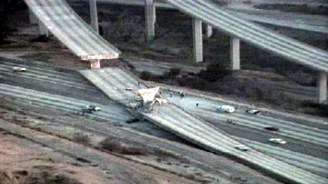
Where were you when the shaking began on Jan. 17, 1994?By Jonathan LloydAerial view of damage from the devastating Northridge earthquake on Jan. 17, 1994.
The deadly magnitude-6.7 Northridge earthquake shook Southern California on this date 18 years ago. About 60 deaths were attributed to the earthquake.
Earthquakes Section: Preparing, Myths, Maps
More than 7,000 people were injured and more than 20,000 people were left homeless, according to the USGS. The magnitude-6.7 quake damaged more than 40,000 buildings and several freeways.Damage occurred over a widespread area of Los Angeles, Ventura, Orange and San Bernardino counties, but some of the most severe damage was reported in the San Fernando Valley.
NBC4 Facebook visitor Tony Del Castillo lived in Van Nuys at the time. He was getting ready for work when the ground began shaking.
Another Facebook page visitor recounted her call to loved ones after the disaster.
"I called my folks that live in Canoga Park, and when my mom got on the phone all she could do was cry," Deborah Hobday wrote. "They had extensive damage to their home and all of their belongings."
Wednesday, January 4, 2012
Now you see it, now you don't: Time cloak created
By SETH BORENSTEIN AP Science WriterWASHINGTON (AP) -- It's one thing to make an object invisible, like Harry Potter's mythical cloak. But scientists have made an entire event impossible to see. They have invented a time masker.
Think of it as an art heist that takes place before your eyes and surveillance cameras. You don't see the thief strolling into the museum, taking the painting down or walking away, but he did. It's not just that the thief is invisible - his whole activity is.
What scientists at Cornell University did was on a much smaller scale, both in terms of events and time. It happened so quickly that it's not even a blink of an eye. Their time cloak lasts an incredibly tiny fraction of a fraction of a second. They hid an event for 40 trillionths of a second, according to a study appearing in Thursday's edition of the journal Nature.
We see events happening as light from them reaches our eyes. Usually it's a continuous flow of light. In the new research, however, scientists were able to interrupt that flow for just an instant.
Other newly created invisibility cloaks fashioned by scientists move the light beams away in the traditional three dimensions. The Cornell team alters not where the light flows but how fast it moves, changing in the dimension of time, not space.
They tinkered with the speed of beams of light in a way that would make it appear to surveillance cameras or laser security beams that an event, such as an art heist, isn't happening.
Another way to think of it is as if scientists edited or erased a split second of history. It's as if you are watching a movie with a scene inserted that you don't see or notice. It's there in the movie, but it's not something you saw, said study co-author Moti Fridman, a physics researcher at Cornell.
The scientists created a lens of not just light, but time. Their method splits light, speeding up one part of light and slowing down another. It creates a gap and that gap is where an event is masked.
"You kind of create a hole in time where an event takes place," said study co-author Alexander Gaeta, director of Cornell's School of Applied and Engineering Physics. "You just don't know that anything ever happened."
This is all happening in beams of light that move too fast for the human eye to see. Using fiber optics, the hole in time is created as light moves along inside a fiber much thinner than a human hair. The scientists shoot the beam of light out, and then with other beams, they create a time lens that splits the light into two different speed beams that create the effect of invisibility by being too fast or too slow. The whole work is a mess of fibers on a long table and almost looks like a pile of spaghetti, Fridman said.
It is the first time that scientists have been able to mask an event in time, a concept only first theorized by Martin McCall, a professor of theoretical optics at Imperial College in London. Gaeta, Fridman and others at Cornell, who had already been working on time lenses, decided to see if they could do what McCall envisioned.
It only took a few months, a blink of an eye in scientific research time.
"It is significant because it opens up a whole new realm to ideas involving invisibility," McCall said.
Researchers at Duke University and in Germany's Karlsruhe Institute of Technology have made progress on making an object appear invisible spatially. The earlier invisibility cloak work bent light around an object in three dimensions.
Between those two approaches, the idea of invisibility will work its way into useful technology, predicts McCall, who wasn't part of either team.
The science is legitimate, but it's still only a fraction of a second, added City College of New York physicist Michio Kaku, who specializes in the physics of science fiction.
"That's not enough time to wander around Hogwarts," Kaku wrote in an email. "The next step therefore will be to increase this time interval, perhaps to a millionth of a second. So we see that there's a long way to go before we have true invisibility as seen in science fiction."
Gaeta said he thinks he can get make the cloak last a millionth of a second or maybe even a thousandth of a second. But McCall said the mathematics dictate that it would take too big a machine - about 18,600 miles long - to make the cloak last a full second.
"You have to start somewhere and this is a proof of concept," Gaeta said.
Still, there are practical applications, Gaeta and Fridman said. This is a way of adding a packet of information to high-speed data unseen without interrupting the flow of information. But that may not be a good thing if used for computer viruses, Fridman conceded.
There may be good uses of this technology, Gaeta said, but "for some reason people are more interested in the more illicit applications."
---
Online
Nature: http://www.nature.com/nature

